
F&B scams in Singapore: More fake restaurant websites take bookings, online orders
Sign up now: Weekly recommendations for the best eats in town

French restaurant Claudine has reported and taken down several fraudulent third-party websites.
PHOTO: CLAUDINE

- F&B businesses in Singapore face rising scams, including fake websites for reservations, impacting restaurants like LeVeL33 and Claudine.
- Diners are affected, with one customer losing more than $3,000 in a Claudine scam. Andy's Pie faced fake order websites, causing customer inconvenience.
- Customers are advised to use official booking systems, while restaurants can secure trademark protection.
AI generated
SINGAPORE – More scams have hit the food and beverage (F&B) industry this festive season, putting several affected business operators on high alert to minimise damage.
The incidents cut across different segments.
They range from impersonation of food delivery platforms to scammers seeking payment to take down bad Google reviews to, more recently, the rise of fake restaurant websites that take reservations and online orders.
Such incidents are not isolated to Singapore.
In South Korea, several news outlets have reported on fake vouchers sold for a meal at the famed Mosu restaurant in Seoul by chef Anh Sung-jae, a judge on Netflix reality show Culinary Class Wars (2024 to present).
Chef Anh posted a photo of the voucher on social media in January, urging the public to beware of imposters. The voucher listed a specific date and time, along with his name and signature.
Prior to this, the restaurant also faced an impersonation scam in March 2025. It involved someone who posed as a telecommunications company employee rerouting calls made to Mosu’s phone number and requesting meal payments from customers.
Fake websites for reservations
In December 2025, The Straits Times reported how LeVeL33 restaurant at Marina Bay Financial Centre had to deal with fake websites – clones of its official one – that surfaced when customers googled keywords such as “level33” and “reservation”.
In the same month, French restaurant Claudine in Dempsey faced a similar incident.
In both cases, diners had made reservations on a fraudulent website and keyed in their credit card details as a pre-authorisation hold – a regular booking procedure on many popular restaurants’ official websites.

LeVeL33 founder Martin Bem was one of the restaurant owners affected by fake websites.
PHOTO: ST FILE
For LeVeL33, some diners flagged suspicious credit card activity where attempted charges of $200 to $2,000 were later made. To his knowledge, all charges were reported and blocked by the relevant credit card issuers, said the restaurant’s founder Martin Bem.
Over at Claudine, one customer was less lucky.
Executive coach Valerie Lim, 62, made a booking on Dec 11 for her daughter’s birthday on Dec 29 for five people – only to realise that her credit card was charged €2,339 (S$3,516) after she keyed in the verification code.
She has made reports to the bank and the police, and the scam is under investigation.
She says: “I am understandably very upset with the way things seem to be unfolding and feel very helpless about the situation.”
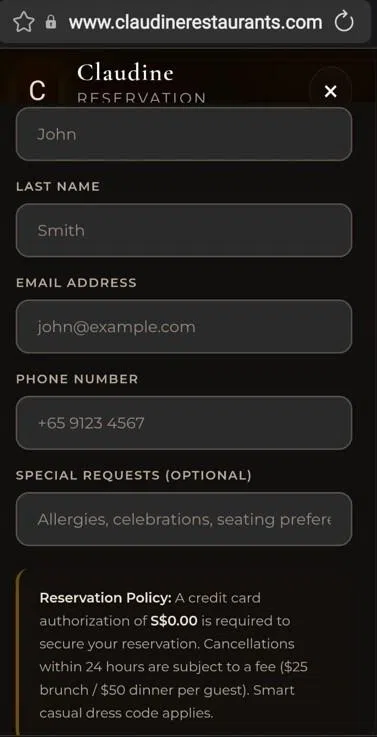
The fraudulent Claudine website that Ms Valerie Lim made her booking on.
PHOTO: VALERIE LIM
The Association of Banks in Singapore highlighted in an October 2025 statement how the industry will continue, together with the Monetary Authority of Singapore and law enforcement, to review, implement and strengthen measures to protect customers from scams.
Mrs Ong-Ang Ai Boon, director of the association, said: “In the fight against scams, customer vigilance remains paramount. Never share personal or account credentials, be wary of suspicious links in SMSes and e-mails, and verify their banks’ contact details before getting in touch with their bank.”
Claudine’s general manager Jacques Alvernhe was first alerted to such scams on Dec 5. Since then, he says it has been an ongoing effort to report and take down several fraudulent third-party websites that are promoted through sponsored Google ads.
The restaurant has also issued guest advisories via its official channels and assisted affected guests by supporting their dispute process. Additional lookalike domain names have also been acquired by the restaurant, he adds, to prevent scammers from further impersonating the brand.
So far, this issue has not affected Claudine’s other sister concepts under home-grown lifestyle company The Lo & Behold Group.
Fraudulent websites for online orders
Others have faced similar impersonation scams. Andy’s Pie – a pie-centric brand by home-grown bakery Home’s Favourite located at Basement at Tangs at Tang Plaza – has seen several fraudulent lookalike websites spring up.
The only legitimate ordering platform for Andy’s Pie is its parent bakery’s website (homesfavourite.com).

The physical store of Andy’s Pie at Basement at Tangs at Tang Plaza.
ST PHOTO: GIN TAY
Shin Min Daily News reported in January that a customer had found at least three websites selling chicken pies under the Andy’s Pie name.
Home’s Favourite’s business and administration manager Cecilia Chin says there are no confirmed financial losses to customers or the business so far, as orders placed on the fraudulent sites state “cash on delivery” as payment terms.
“However, the incident has caused inconvenience and disappointment to customers who placed orders that were never fulfilled. These unauthorised websites pose a risk of confusing customers and undermining trust in our brands. We take this seriously and have put out advisories on our social media channels to reassure customers and protect our reputation,” she says.
Other suspicious encounters
Chef-owners ST spoke to also flagged other suspicious encounters regarding diners making reservations.
French bistro Summer Hill’s Anthony Yeoh and burger restaurant Relish’s Willin Low have had multiple diners show up saying they had made bookings that were not recorded in the system.

French bistro Summer Hill’s Anthony Yeoh (above) has had diners show up saying they made bookings that were not recorded in the system.
PHOTO: ST FILE
Chef Low’s team had to deal with a website that has no affiliation with the restaurant, but had taken bookings via an alleged third-party agent for diners at Relish.
He says: “Though there was no financial loss to the business, there was reputational damage due to perceived scam association, and operational disruption from customers turning up without reservations insisting they have paid a fee to get a table.”
What can businesses and diners do?
Chef Low’s advice is to make reservations only via a restaurant’s official website booking system and phone number. Meanwhile, chef Yeoh takes the extra step of informing guests via WhatsApp that a link has been sent to them to confirm their booking.

Burger restaurant Relish’s Willin Low (above) has had diners show up saying they made bookings that were not recorded in the system.
PHOTO: ST FILE
Mr Alvernhe of Claudine highlights the importance of securing trademark protection. This helps to expedite the takedown process of fraudulent websites by enabling platform providers to quickly verify brand ownership and act on impersonation claims.
Claudine’s name has been trademarked since it opened in 2021, along with its sister brands, including three-Michelin-starred Odette at National Gallery Singapore. He says the group is reviewing and working towards securing trademark protection for all its concepts.
Of these fraudulent developments, chef Yeoh notes: “All this has made restaurant owners, even those unaffected so far, very wary and more alert. The worry is that guests who want to book with us get turned off. Imagine, your first experience with a restaurant ends in credit card fraud. The memory will not be a good one and you might not be as inclined to return.
“Which is why it’s important for businesses that spot these incidents to check them out for the safety of the customer. Then they know you’re taking it seriously and protecting them.”

For e-commerce platform Oddle, which supports restaurants with reservations, ordering and payments, its founder Jonathan Lim says the company has helped F&B merchants deal with various scam attempts over the years.
This includes strengthening security measures, monitoring suspicious activity patterns and working closely with payment partners to prevent fraudulent transactions.
Oddle does not store card details and all payments are processed through secure, compliant payment providers, he adds.
He adds that greater awareness and vigilance across the ecosystem helps reduce such incidents.
“Scammers are very creative. They adapt quickly, go quiet and often return with new tactics. That means platforms like ours have to constantly strengthen security and respond fast. At the same time, consumers also need to stay alert, just like with any other scam.”
