
2026 food trends: Chefs foresee the rise of regional ingredients, sustainable cooking
Sign up now: Weekly recommendations for the best eats in town

Chefs like Loca Niru's executive chef Shusuke Kubota hope to use more local produce in seasonal menus.
PHOTO: JOHN HENG


SINGAPORE – Every few months, a new hero ingredient surfaces, buoyed, as is often the case these days, on the waterways of various algorithms. Before you know it, it is everywhere, begging to be used, demanding to be sampled.
In 2025, the inescapables were matcha, Chinese food brands and, for a period of time, chilli crab everything (thanks, SG60).
Specific dishes like banana pudding and pizza also attained a more contained degree of ubiquity, owing respectively to a TikTok trend that seized cafes here like a strain of flu, and the proliferation of artisanal pizzerias.

Pizza proved popular in 2025, with new artisanal pizzerias like Pizza Studio Tamaki opening in Singapore.
PHOTO: PIZZA STUDIO TAMAKI
There are the quieter shifts, too, that slip into kitchens and dining rooms without the same influencer-stoked fanfare. The tentative embrace of alternative produce like Asian wines, for instance. Or a reformulation: Chefs, increasingly, are racking their brains over how to lure diners back with better-value offerings while locked in the immovable matrix of rising costs and consumer apathy.
With so many competing pressures and influences, cooking can be a noisy business. While most chefs agree that diners drive food trends, it is left to discerning professionals to sift the wheat from the chaff, the genuinely delicious from faddish nonsense.
What does 2026 have in store? Here is what chefs think will be on the menu in the next 12 months.
Embracing the region
Mod-Sin – the interpretation of Singaporean flavours through contemporary techniques – was once a way of cooking so unconventional, it merited its own name.
As Singapore’s culinary scene matures, however, chefs expect to see more local and regional ingredients percolating through the ecosystem.
Mr Francois Mermilliod, 50, executive chef of private members’ club 67 Pall Mall, attributes this to a “collective awakening”.
“Diners are increasingly conscious of environmental impact. Chefs are stepping into the role of educators and custodians of culinary culture, and regional producers are pushing boundaries in quality.”
Ms Sujatha Asokan, 34, chef de cuisine of South-east Asian restaurant Quenino in Cuscaden Road, says the shift makes sense.
She integrates herbs like ginger flower, jungle garlic and turmeric into her cooking, which pays tribute to local staples like chicken rice and assam laksa.
“Diners today are more curious, more informed and more open to flavours that come from a real place. They’re not looking for luxury in the traditional sense any more. They want meaning, provenance and a story they can taste.”

Quenino’s Yellowtail Kingfish features white fungus with ginger flower, a key ingredient in South-east Asian cooking.
PHOTO: QUENINO
She started noticing a growing appreciation for South-east Asian flavours in 2025. No longer are diners satisfied with “elevated” versions of comfort dishes. They want thoughtfully constructed dishes that help them perceive familiar flavours through new eyes.
“Many locals tell us that they are learning more about the ingredients they have eaten all their lives, simply because they have never seen them treated this way. For me, that is one of the best compliments we can get,” she says.
Mr Lamley Chua, executive chef of CapitaSpring bar 1-Arden, also predicts renewed interest in hyper-local ingredients, native herbs and forgotten plants, as well as the rise of zero-waste umami – in which every part of the ingredient is used to create a richer, more natural flavour.
He has responded to this shift by obtaining more produce from the restaurant’s garden and collaborating with small growers.
“I’ll keep using them at the core of the dish, not just as garnish. Whether it’s a broth made from by-products or a main element using garden herbs, the approach is to let these flavours carry the dish, not sit in the background,” says the 40-year-old, who is also head of Asian cuisine development at lifestyle and hospitality company 1-Group. “The more I experiment, the more the ingredient tells me what it wants to be.”

The garden at 1-Arden, where herbs used in the rooftop bar are grown.
PHOTO: 1-ARDEN
It helps that suppliers have started bringing in better regional produce, as well as supporting smaller local makers. “That changes the playing field for us in the kitchen. Suddenly, I have access to an ingredient I used to see only when travelling, or a better version of something I could not get consistently in the past,” says Quenino’s chef Asokan.
However, Shusuke Kubota, executive chef of restaurant Loca Niru, which serves Japanese food with South-east Asian accents at its Penang Road premises, says supply chains for such ingredients are not yet robust enough.
“Suppliers do not always prioritise importing them. This makes the supply chain weaker compared to more common products,” says the 33-year-old.
“For example, Japanese ingredients can arrive four times a week, but for certain items from Malaysia, we may get deliveries only twice a week. This means planning is very important, and we have to work carefully to keep the quality consistent.”
Consistency, too, remains an issue. A lot of chef Asokan’s produce comes from places like the Cameron Highlands or smaller farms, which are exposed to the elements and yield greens that are beautiful one week and unusable the next. For ingredients with unique tastes like ulam raja or moringa leaf, this can be especially frustrating.
“If we cannot get them, there is no one-to-one substitute. When that happens, we have to decide whether to rework the dish, find an entirely new direction or, in some cases, take it off the menu. It is quite painful when you have spent months developing and testing the dish,” she says.
Still, she is certain that these ingredients have a permanent place in Singapore’s evolving larder because of their cultural and emotional resonance.
And since this realm of flavour is still relatively nascent – in fine and casual-fine circles, at least – chef Kubota anticipates room for innovation and wilder creativity.
Also optimistic is Mr Ryan Nile Choo, 35, chef-partner of bistros Marcy’s and Maggie’s in Duxton Road and Keong Saik Road respectively. “What excites me for 2026 is the way ingredients from different regions can intersect quietly and naturally, instead of shouting about fusion.”
For instance: Filipino cane vinegar in a salsa verde laced with Sichuan peppercorn or Vietnamese fish sauce whisked into a light vinaigrette, giving raw seafood or vegetables a gentle savoury backbone rather than just being a dip on the side.
“Not every dish has to be ‘ground-breaking’. Sometimes the most satisfying thing is taking something recognisable and adjusting it with one or two unexpected ingredients so it feels both comforting and new. For me, that feels more honest and sustainable than trying to engineer a dramatic 50-50 fusion every time.”

Chef Ryan Nile Choo of Marcy’s and Maggie’s says he now builds dishes from a memory of a flavour or a feeling.
PHOTO: MARCY’S
To him, this more considerate approach to food is part of a move away from vague labels like “Asian flavours” – that, in his view, obscure specific memories by blurring everything into one exotic-sounding blob – and into something more third-culture and region-specific.
The way he develops dishes has concomitantly changed. “I used to start from a technical idea – for example: ‘let’s build a raw fish dish’. Now, I often start from a memory of a flavour or a feeling, something from a particular street, home kitchen or trip, then build the dish around that.”
Healthy and sustainable
Discerning diners with higher expectations will force chefs to pay closer attention not just to where their food is obtained, but also how.
Which is why Mr Nicolas Tam, 35, chef-owner of Willow in Hongkong Street, thinks sustainable line-caught seafood will emerge as a key ingredient in the new year. “More people are concerned about the safety and future of our seas for our next generation,” he says.
Health concerns play a part too – there have been reports of farmed fish with high levels of antibiotics. Poor farming conditions have also resulted in some low-quality products.
It is for this reason that Mr Dicky To, 51, senior executive chef of Tong Le Private Dining, sees diners gravitating towards fish that tastes clean and possesses good texture – grouper, for instance.
“When people dine at Tong Le Private Dining and orders seafood, they’re placing their trust in my team and me, trusting that we have handled every detail with care before it even reaches the table,” he says.
“It is our responsibility to explain which ingredients we choose specifically because of sustainability considerations.”
Interest in health foods like nuts and berries is likely to pick up too, he thinks. And the low-carb movement is likely here to stay, propelled by mindful millennials who feel a strong sense of responsibility to encourage healthier eating habits among their parents’ generation.
“Consumers are increasingly health-conscious,” concurs Mr Andrea De Paola, group executive chef of Food Concepts Group, which runs restaurants like 54 Steakhouse in Amoy Street, as well as Italian restaurants Altro Zafferano at the Ocean Financial Centre and Griglia Open Fire Italian Kitchen in Craig Road and Katong.
“They seek superfood and vegetable dishes that match the satisfaction of traditional protein sources, like fish.”
The 34-year-old foresees a growing appetite for dishes showcasing a wide selection of forgotten vegetables, plant-based seafood and innovative protein alternatives, particularly precision-fermented and mycelium-based ingredients.
He is also hopeful that the new year will see a stronger commitment to zero-waste cooking.

Caesar salad at 54 Steakhouse. Group executive chef Andrea De Paola foresees more dishes showcasing forgotten vegetables in 2026.
PHOTO: 54 STEAKHOUSE
While sustainability has yet to become a top priority in Singapore’s kitchens, he is doing what he can to move the needle.
Griglia, for one, will offer more veggie-centric options and secondary cuts with better value, while 54 Steakhouse adopts a nose-to-tail approach to food. Beef trimmings, for instance, are used for dashi, and crab shells are turned into bread.
The team is experimenting with fermentation as well. Such techniques, according to Mr Taro Takayama, 44, resident chef of Kappo restaurant Ki-Sho in Scotts Road, reduce waste by extending the life of ingredients.
“For me, sustainability is a natural result of respecting traditional methods,” he says, adding that diners will look for flavours that are quietly complex.
“Fermentation has always been central to Japanese cuisine, and we’re seeing a renewed appreciation for the subtle elegance it brings. Ingredients like koji, miso and naturally fermented seafood help chefs build layers of savouriness without heaviness, resulting in dishes that feel clean, balanced and timeless.”

Fermented tea leaves and fish at Club Rangoon.
ST PHOTO: HESTER TAN
So, too, with Burmese cooking. In the coming year, Ms Charrinn Singdaechakarn, executive chef of Burmese restaurant Club Rangoon in Duxton Road, hopes to see a greater appreciation for ingredients like laphet – fermented tea leaves increasingly used in pesto, gremolata, hummus, bagels and other non-traditionally Burmese dishes – and ngapi, a punchy fermented fish paste.
Though many Singaporeans are new to Burmese food, the 42-year-old says diners are open to sampling these flavours.
“More people are interested in where their food actually comes from. You see this from the questions they ask about the ingredients: Is it locally sourced? Imported? Diner habits have become a little more interactive, inquisitive and curious, rather than just blindly consuming whatever is on their plate.”
Hanwoo beef and Japanese wine
While only a seer would be able to predict exactly which ingredients will blow up in 2026, some chefs have put their money on a few potential rising stars – like Hanwoo beef, freshly approved for export to Singapore.
An agreement was reached when Singapore and South Korea upgraded ties to a strategic partnership in November. The following month, Yonhap News Agency reported that the first shipment of Hanwoo beef and Jeju pork had landed in Singapore.
These prized cuts are available from retailers like Jun’s Butchery and Culina, as well as at restaurants like Cote Korean Steakhouse at Como Orchard, 54 Steakhouse in Amoy Street, Seoul Restaurant at Conrad Singapore Orchard, Labyrinth at the Esplanade and Nae:um in Telok Ayer Street.
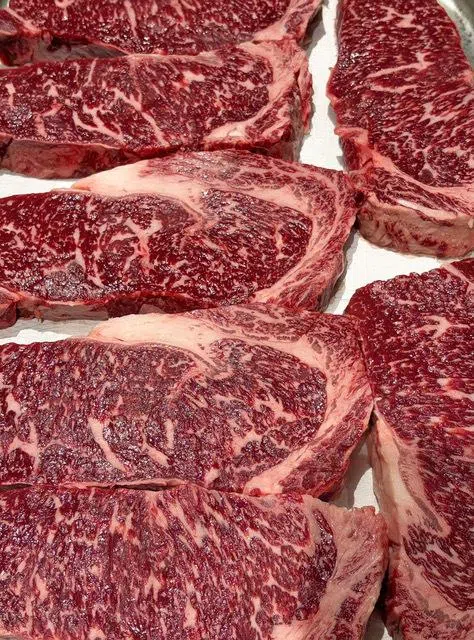
Hanwoo beef will be available at restaurants and grocers across Singapore in 2026.
PHOTO: GU:UM
Mr Louis Han, chef-owner of Nae:um and Korean steakhouse GU:UM, believes the novelty of these ingredients will intrigue Singaporean diners, who by and large do not need to be cajoled into embracing South Korean exports.
“Compared with wagyu, it has a nice balance of meatiness and fat, so it would attract diners who aren’t too much into fatty beef but still want to consume premium ingredients,” says the 35-year-old, predicting that venues able to get their hands on this sought-after product will enjoy a surge in popularity.
“We intend to bring in Hanwoo as soon as possible. GU:UM is known for authentic Korean-style marination for our meats, and I am very excited to showcase the variety of flavours and textures Hanwoo has to offer using our type of marination.”
Only time will tell if wagyu – the perennial favourite of Singaporean diners – will cede dominance to Hanwoo beef. Meanwhile, Japan is laying claim to another gastronomic sphere: wine.
Pastry chef Makoto Arami, 36, who helms Ami Patisserie in Scotts Road, foresees the continued rise of Japanese wine bars and Asian wines. According to the Embassy of Japan in Singapore and the Japan External Trade Organization, the value of Japanese wine to the Republic rose from 18 million yen (S$147,550) in 2020 to 51 million yen in 2024.
“Singapore’s bar culture is still very vibrant, and the demand for interesting alcoholic beverages remains high. Japanese wine, in particular, is improving in quality year by year. Producers are putting a lot of effort and passion into their craft,” says chef Arami.
“Even though the price point can be higher, the rarity, story and novelty will attract diners who are curious and willing to explore.”

Japanese wines, like these bottles from three-Michelin-starred restaurant Odette, are gaining traction in Singapore.
ST PHOTO: AZMI ATHNI
He plans to find thoughtful ways to pair such wines, sake and teas with his omakase menu, as well as incorporate Japanese alcohol into his pastries.
He is particularly interested in clean, mineral-driven white wines with a savoury character and a creamy texture, which pair well with his savoury dishes. On the other hand, popular Hokkaido wines like Niagara, which have floral and sweet notes, complement desserts beautifully.
“It requires a lot of tasting and comparison to find the right pairings and achieve good balance.”
To chef Arami, Japanese wine is special because of its quality and rarity. The smaller scale of production also means that wine producers can afford to pay more attention to detail, giving their wines a distinctive character.
There is a more personal reason for his interest in Japanese wines too. “As a Japanese chef working in Singapore, using Japanese wine allows me to share a part of my home and culture with our guests.”
