
Doctor describes and denounces CIA practice of ‘rectal feeding’ of Guantanamo prisoners
Sign up now: Get ST's newsletters delivered to your inbox

A group of people dressed as prisoners protest outside of the US Capitol over atrocities committed by the US military in Guantanamo Bay Detention Camp.
PHOTO: REUTERS

GUANTANAMO BAY, Cuba – Over the years, the Central Intelligence Agency’s (CIA) use of waterboarding and other forms of torture in its secret overseas prisons after the Sept 11, 2001, attacks has been revealed in government leaks, testimony and a damning Senate investigation.
But an expert’s testimony this week in pretrial hearings at Guantanamo Bay offered some of the most graphic details made public about the CIA’s shadowy use of rectal feeding on its prisoners, a discredited practice kept secret long after other torture methods had been exposed.
This comes as the United States military released two brothers who were held as detainees in Guantanamo for supposedly helping to operate safe houses where suspected operatives of Al-Qaeda holed up after the Sept 11 attacks.
Dr Sondra Crosby, a court-approved expert on torture and other trauma, testified in a long-running defence effort by lawyers for Abd al-Rahim al-Nashiri, who is accused of orchestrating the 2000 bombing of the USS Cole.
The lawyers are seeking to suppress from his eventual trial admissions he made to federal investigators as tainted by torture.
She held up a tube that is designed to be put in a patient’s windpipe and said that – according to the agency’s once-secret records – CIA prison staff inserted one just like it into Nashiri’s anus in May 2004.
Agency personnel then used a syringe to inject a nutritional shake into his body.
She testified that at Guantanamo Bay in 2013, Nashiri confided that, years earlier, CIA personnel grabbed him from his cell, stripped him naked, shackled him at the wrists and ankles, bent him over a chair and administered the liquid.
“This was a very, very distressing painful, shameful stigmatising event,” Dr Crosby testified.
“He experienced it as a violent rape, sexual assault.”
Released after 20 years
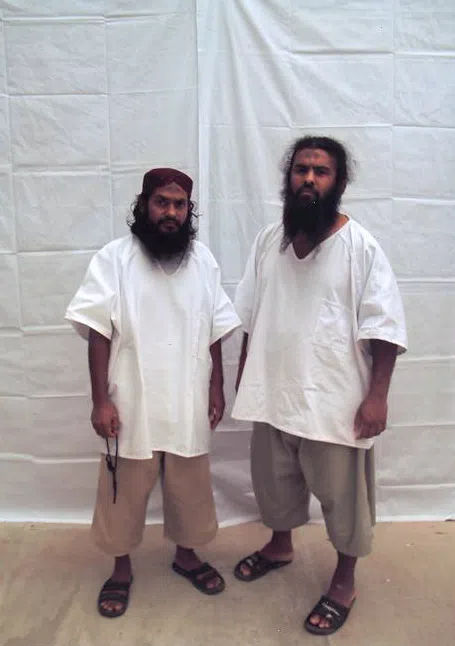
A 2013 picture of Mohammed Ahmed Ghulam Rabbani (left) and Abdul Rahim Ghulam Rabbani at Guant‡namo Bay in Cuba.
PHOTO: NYTIMES
The Pentagon said, meanwhile, that Mr Mohammed Ahmed Ghulam Rabbani, 53, and Mr Abdul Rahim Ghulam Rabbani, 55, who were never charged with any crimes during 20 years in US custody, were flown to Pakistan in an arrangement with the authorities there.
The brothers were captured by Pakistan’s security services in Karachi in September 2002.
They arrived at Guantanamo in 2004 after being kept at a CIA-run detention site in Afghanistan for about 550 days.
They were approved for transfer in 2021. It is unclear why they remained in prison.
In the interim, the Pentagon released two other Pakistani prisoners. Saifullah Paracha, 75, was repatriated in October. Majid Khan, 42, was freed in Belize under a resettlement agreement in February.
The younger Mr Rabbani, who goes by Ahmed, distinguished himself at Guantanamo as both a prolific artist and a determined hunger striker who survived on nutritional supplements, sometimes forcibly fed to him through a tube.
Before Mr Ahmed Rabbani’s release, the Pentagon partially lifted a ban on the release of artwork made by prisoners at Guantanamo.
His lawyers were eager to learn if he was allowed to take the more than 100 paintings he amassed in his years of detention with him on the military cargo plane that flew him and his brother to Pakistan.
‘Very damaged’
Less was known about the older brother.
Ms Agnieszka Fryszman, a lawyer who has represented him pro bono since 2006, told a parole board at the time that “he has kept himself busy with simple pursuits. He sweeps and cleans his block, for example, and stays away from conflict”.
The brothers are described in US intelligence documents as Pakistanis by nationality, though they were born and raised in Mecca, Saudi Arabia, and are ethnically Rohingya.
Both have families in Karachi and were working as part-time taxi drivers before they were seized.
Because they were fluent in Arabic, they also found work running errands and aspects of safe houses for the former Al-Qaeda operations chief Khalid Shaikh Mohammed, who is charged in a death-penalty case at Guantanamo as the accused mastermind of the Sept 11 attacks.
In 2016, a US military officer at Guantanamo told a parole-style review board that Mr Ahmed Rabbani “was a shrewd and cunning businessman and chased after the almighty dollar. He did not really care to find out who he was working with, but he stresses that he was working for money, not for a religious cause or an agenda”.
Mr Clive Stafford Smith, a lawyer who has represented both men, said Mr Ahmed Rabbani was “very damaged” from a seven-year hunger strike that began in early 2013 and “has a hard time holding food down. But he is getting better on that front”.
“The irony is that today, and all through his hunger strike, when they were in communal living, he would cook for the other men,” said Mr Stafford Smith, adding that the younger Mr Rabbani wants to run a restaurant after he is reunited with his family.
The brothers’ departure reduced the detainee population at Guantanamo to 32 men, all sent there during the years of the George W. Bush administration.
Across the years, the US has held about 780 detainees at the once-sprawling prison complex.
At its peak, in 2003, the military held 680 prisoners there at one time. NYTIMES
