
Ministerial committee to deal with supply shocks, price increases from Mid-East conflict: Shanmugam
Sign up now: Get ST's newsletters delivered to your inbox

Coordinating Minister for National Security and Minister for Home Affairs K. Shanmugam speaking to the media on the sidelines of a community event in Yishun on April 4.
ST PHOTO: CHONG JUN LIANG

- Singapore's HCMC, chaired by Mr Shanmugam, will address Middle East conflict impacts: supply disruptions, price increases, and diplomatic issues.
- Singapore hasn't curbed fuel use like other nations; approach to the crisis will be detailed in Parliament next week.
- The HCMC, with 15 members, coordinates government response, with support measures from Budget 2026 expedited.
AI generated
Follow our live coverage here.
SINGAPORE – The Homefront Crisis Ministerial Committee (HCMC) will address supply disruptions and price increases arising from the Middle East conflict, as well as diplomatic and security issues, said Coordinating Minister for National Security K. Shanmugam.
He added that the Government will set out its approach to the crisis when Parliament sits next week.
Speaking to the media in his first update as the chairman of the HCMC, Mr Shanmugam said Singapore has not yet taken measures adopted by other countries to curb fuel and energy consumption to mitigate the impact of the conflict in the Middle East.
He added that the conflict in the Middle East has affected a significant part of the world’s oil and gas supply, and that supply disruptions will persist even if the war ends soon.
This has also driven up prices of food, fuel and fertiliser.
Said Mr Shanmugam, who is also Minister for Home Affairs: “There is a crisis on. It requires coordination across different ministries. There’s impact on the ground, and we will need to deal with it.”
He added: “It’s a serious situation all around the world. You’ve seen in many parts of the world, many countries have taken measures to cut back on the use of electricity, use of fuel.
“We haven’t taken those measures yet, and we will explain how we approach it.”
Among the moves taken by other countries to cushion the impact of the global energy crisis is a work-from-home directive for Malaysia’s public sector, statutory bodies and government-linked companies that will take effect starting from April 15.
In two Australian states, public transport has been made free in order to incentivise people not to drive.
Mr Shanmugam, who was speaking on the sidelines of a community event in Yishun where he is an MP, said the HCMC has been convened for a few weeks and has held meetings.
The committee has 15 members including Cabinet ministers such as Mr Shanmugam, and Deputy Prime Minister and Minister for Trade and Industry Gan Kim Yong, who is its adviser.
Other members include Coordinating Minister for Public Services and Defence Minister Chan Chun Sing, Coordinating Minister for Social Policies and Health Minister Ong Ye Kung, Minister-in-charge of Energy and Science & Technology and Manpower Minister Tan See Leng, and Foreign Minister Vivian Balakrishnan.
The Homefront Crisis Executive Group, made up of senior civil servants from various ministries and agencies, has been at work for some time, he said. The group ensures decisions by the HCMC are implemented and that ministries are aligned in their response to a crisis.
The HCMC, convened by Prime Minister Lawrence Wong to coordinate Singapore’s national response to the crisis, is the political leadership charged with setting the direction and providing strategic guidance for the overall government response to major crises.
Announcing the formation of the committee on April 2, PM Wong, who is also Finance Minister, also said that some support measures announced at Budget 2026 will be brought forward to provide earlier relief and cushion the Middle East conflict’s impact on Singapore households and businesses.
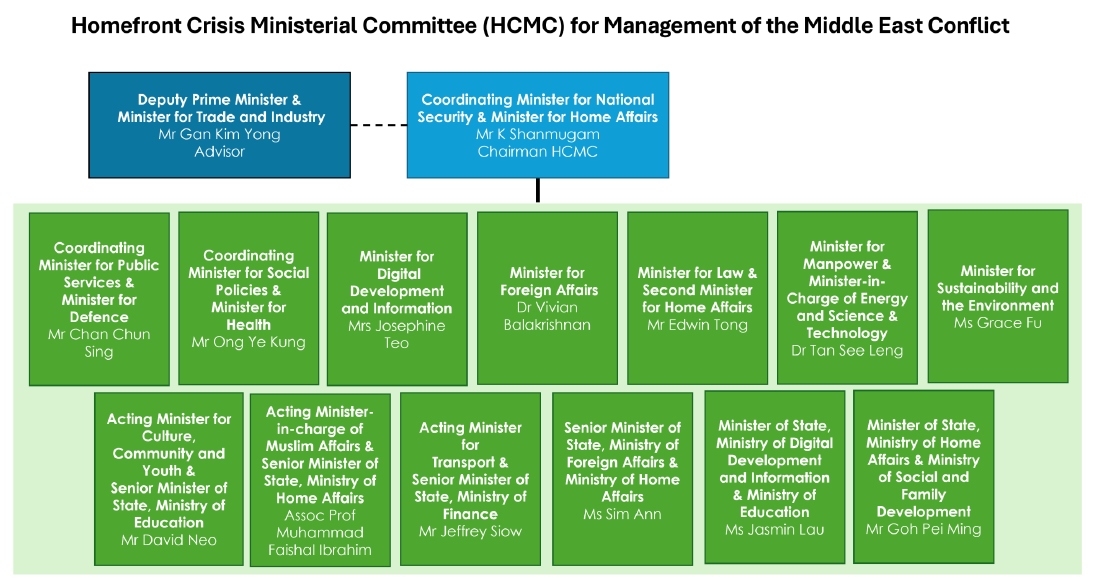
PHOTO: MHA
When asked why the HCMC has been set up now, Mr Shanmugam said that managing the fallout from the Middle East conflict requires coordination across different ministries.
The impact on the ground requires planning to maintain the supply of fuel and electricity, he said, citing rising costs faced by delivery riders as an example.
“The Government is there to deal with these issues,” he said.
