
New HDB site shrunk to preserve part of forest in Sembawang
Sign up now: Get ST's newsletters delivered to your inbox

- The Housing & Development Board (HDB) will reduce the development footprint of a planned housing site in Sembawang following an environmental impact assessment.
- Despite these efforts, the EIA acknowledges that biodiversity loss and noise disturbance are inevitable.
- Separately, an EIA for the Tengah Town Centre site recommends protecting a 0.8-hectare plot of Tengah forest.
AI generated
SINGAPORE – A new Sembawang housing site will be scaled back to protect wildlife and preserve remnants of freshwater swamp forest, one of Singapore’s most endangered ecosystems.
The Housing Board told The Straits Times on June 25 that nearly 30 per cent of the vegetated site will be “left as-is”, with no immediate plans for development.
This sets aside roughly 6ha of the area’s forest, grassland and scrubland – equivalent to about eight football fields – owing to its ecological value.
Plans for the Sembawang neighbourhood were outlined in one of two environmental impact assessments (EIAs) published by the agency last week.
The second report detailed the ecological effects of clearing parts of Tengah forest for the future Tengah Town Centre.
According to the Sembawang report, the rest of the land on the roughly 21ha site is slated to be cleared for housing from 2028, as zoned by the Urban Redevelopment Authority’s Master Plan since 2003.

The Sembawang report prepared by engineering consultant Aecom, which had been commissioned to conduct the study in 2025, also recommended reducing the development’s footprint.
The site was once home to a natural mangrove swamp, but the area had been developed for Sembawang Naval Base and other facilities. Nature began to return after the 1970s with the closure of the naval base.
Over the decades, plants characteristic of freshwater swamp forests previously recorded along Seletar Reservoir regenerated.

A Sunda pangolin in Windsor Park.
PHOTO: NATIONAL PARKS BOARD
The report also highlighted that retaining vegetation will provide safe passage for wildlife detected on the site. This includes the globally critically endangered Sunda pangolin and the straw-headed bulbul, a songbird for which Singapore acts as a global stronghold, according to the report.
This green corridor acts as a stepping stone for birds moving between northern green spaces, such as the upcoming Mandai Mangrove and Mudflat Nature Park, and the south.
In total, 148 animal species and 198 plant species were documented in the site, based on the study.
The report warned that failing to retain a buffer for the plots would reduce the survivability, long-term regeneration and dispersal of sensitive species.
While HDB will retain the majority of the recommended conservation area, the revised development footprint will still cut into one site that provides a microclimate conducive to the freshwater swamp forest.
To mitigate the environmental impact of the housing estate’s development, the report also proposed a raft of measures such as transplanting flora significant for conservation and restricting night works after 6pm to minimise noise disturbance to nocturnal animals.
To guide development plans for both sites, HDB engaged nature groups, including Nature Society Singapore and Singapore Youth Voices for Biodiversity (SYVB).
Nature Society Singapore’s assistant director for conservation Albert Liu welcomed HDB’s scaling back of the development boundary for biodiversity.
“It’s not enough because ideally, you would give up all of the areas recommended for conservation, but to me they’ve already studied it, so this is the best compromise that they’ve made,” he said.
He urged HDB to ensure sufficient buffers, such as parks, are placed between the housing blocks and the forested areas to minimise the risk of birds colliding with high-rise buildings.
During construction, stickers that make glass surfaces visible to birds can also be applied to alert the animals to the presence of man-made structures, which are the top contributor to bird deaths reported here, he said.
Liu also stressed the need to manage home buyer expectations of encountering wildlife during the Build-To-Order bidding process.
“You can’t cherry-pick parts of nature, things that you want and don’t want,” he said. “If residents are not willing to accept this package of wildlife, then don’t bid for it.”
SYVB’s head of programmes Isaac Ong welcomed AECOM’s modelling of the connections between the site and surrounding ecosystems in the area, noting that it has not been a common practice.
“It will be good to carry forward such a practice, as developments tend to be narrowly focused on impacts directly within site boundaries,” said the National University of Singapore student.
Separately, the EIA for the Tengah Town Centre examined a site of about 16.7ha, which is almost entirely covered by vegetation.
The report, conducted by consultancy EnviroSolutions & Consulting, recommended minimising the clearance footprint and managing fauna access to reduce biodiversity loss, among other things.
HDB said it will strive to avoid developing about 0.8ha of the area that supports a larger corridor for wildlife across Tengah’s green spaces as identified in a 2021 study. This amounts to about 4.8 per cent of the site.
The exact date of the development was not disclosed.
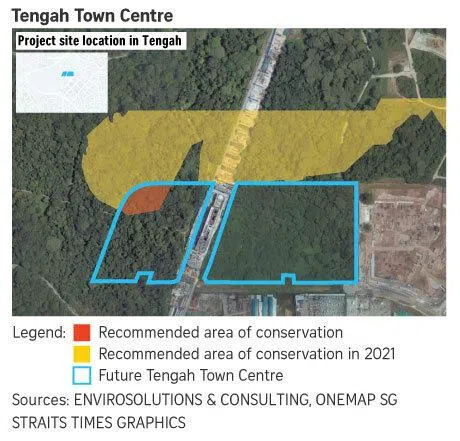
Commenting on the Tengah study, Liu likened its limited scope to “looking through a straw”, though he noted that the authorities have agreed to begin showing how various environmental impact sites connect holistically.
Beyond EIA engagements, he called for nature groups to be involved in more environmental management and monitoring plans (EMMPs), which handle the risks that occur when the projects are executed.
Said Liu: “EIA is just talking about design. Nothing is being operationalised and executed. But it’s in the execution of (EMMPs) that we’ve seen things gone wrong.”
He cited the Land Transport Authority’s handling of the Cross Island Line as a positive example of engaging the community beyond a development’s design, noting that the agency proactively updates nature groups on the progress of construction.
SYVB’s Ong called for HDB to adopt the consultancy’s recommendation of salvaging cuttings from large, threatened fig trees that will be cleared, and replanting them in forested areas adjacent to the development.
HDB said: “The mitigation measures will be finalised after all public feedback has been reviewed, and where appropriate, additional measures or monitoring requirements may be incorporated.”
The public can provide feedback for both the Sembawang and Tengah EIA reports until 6pm on July 16 at str.sg/kxRH
