
Home Team must stand ready to counter risks posed by Middle East conflict: Shanmugam
Sign up now: Get ST's newsletters delivered to your inbox

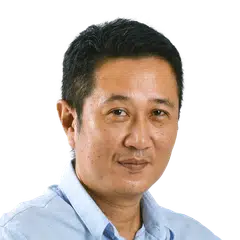
Home Affairs Minister K. Shanmugam at the Home Team Promotion Ceremony 2026 for senior officers in the Volunteer Special Constabulary, Civil Defence Auxiliary Unit and civilian schemes of service on April 13.
ST PHOTO: AZMI ATHNI
SINGAPORE – The Home Team in Singapore must stand ready to counter security risks, including the threat of terrorism, as the effects of the ongoing conflict in the Middle East spread globally.
Speaking at a Home Team promotion ceremony on April 13, Coordinating Minister for National Security K. Shanmugam said that since the start of the war, the Islamic Revolutionary Guard Corps and its proxies have been launching attacks on Israel and the Gulf states.
There have also been attacks targeting US, Jewish and Israeli institutions in various European countries.
The minister noted that there have been serious reports for many years on the presence of Hamas operatives in neighbouring countries as well.
“These proxies are not confined to the Middle East. This is something we are watching closely,” said Mr Shanmugam, who is also Minister for Home Affairs, at the event held at Orchard Hotel.
The minister had previously noted that terrorist groups and their affiliates have capitalised on the conflict to disseminate online propaganda justifying violence and inciting terrorist attacks.
In a written reply to Parliament on April 8, Mr Shanmugam said these extremist narratives have increased the risk of self-radicalisation, particularly in cyberspace.
“Since the escalation of the Israel-Hamas conflict in October 2023, the Internal Security Department has detained or issued Restriction Orders to six Singaporeans under the Internal Security Act, whose radicalisation was triggered or accelerated by the ongoing conflict in the Middle East,” said the minister.
He said the conflict in the Middle East poses a risk to Singapore, with the high numbers of travellers entering the country.
Mr Shanmugam noted that in 2025, the Immigration and Checkpoints Authority (ICA) cleared almost 245 million travellers.
He added: “186 million of these came through our land checkpoints – an average of half a million people per day.”
The minister said the Home Team has to try and counter this threat.
“ICA has increased security checks at our checkpoints,” he said. “Police have stepped up their roles in areas of concern.”
Addressing the officers, Mr Shanmugam said the world outside of Singapore cannot be ignored.
“It’s important that as senior leaders in the Home Team, you understand what is going on because it has implications on all of your work.”
In his speech, Mr Shanmugam noted that while some may have expected Iran to surrender within days due to the US and Israeli military might and the assassination of its political and religious leadership in air strikes, the Iranian regime remains intact.
Meanwhile, the Strait of Hormuz, which sees the transit of a quarter of the world’s supply of seaborne oil and one-fifth of its gas, has continued to be put under a blockade by the Iranian authorities.
Iran has also attacked close to 20 civilian vessels attempting to pass through the strait. It has also placed mines in the strait, reportedly demanding a US$2 million (S$2.6 million) toll for commercial ships to pass through the strait.
“Anyone looking at it would have known it’s never going to be easy to force Iran to change its position on its nuclear programme, or to achieve regime change through aerial bombardment alone,” said Mr Shanmugam.
“The way the conflict has played out showed this, and Iran has now doubled down on securing its core interest of regime survival.”
Without a doubt, Singapore, which is a small and open economy, will face an economic impact, he said.
“We import nearly all our energy,” added Mr Shanmugam.
“Fuel and electricity costs will go up because everything depends on fuel and energy, and therefore pretty much everything will be affected... We do not know how long these disruptions will last.”
But in these uncertain times, Singapore stands by its principle of free passage across any strait.
“Our position is, under the United Nations Convention on the Law of the Sea, and customary international law, there is free right to transit passage across such straits, and that no one can impose tolls or selectively decide whose ships get access to these waters,” said Mr Shanmugam.
“And we are very wary when other countries treat navigational rights and freedoms as discretionary privileges to be negotiated or paid for.”
He gave the example of the Strait of Malacca, which connects the Indian Ocean to the west, and the Singapore Strait leading to the South China Sea in the east.
“Thirty per cent of the world’s global trade flows through it,” said Mr Shanmugam.
“It sustains the maritime sector in Singapore, which accounts for 7 per cent of our annual GDP and employs over 170,000 people.”
The narrowest point of the Strait of Malacca is less than two nautical miles, while the narrowest point in the Strait of Hormuz is 21 nautical miles.
“How should we respond when someone says – civilian ships have to pay a toll to pass through the Strait of Malacca, otherwise, they face missiles, mines or drone strikes?” Mr Shanmugam asked.
In his speech, he noted the reactions by some Malaysian politicians, including Mr Syahredzan Johan, vice-president of the Democratic Action Party, who said that the Malaysian “government will do what is needed to protect the people of Malaysia, including negotiating for passage through the Strait of Hormuz”.
Mr Shanmugam said Malaysian Prime Minister Anwar Ibrahim, on the other hand, has acknowledged that Singapore’s position is its matter and it is important for Singapore and Malaysia to maintain their friendship.
“We appreciate his statement. This is not a case of Singapore siding with the US or Western countries. We have said what we have said in our own strategic interest – consistent with international law,” Mr Shanmugam added.
Before ending his speech, the minister reminded the officers that a key enabler for success as a Home Team leader is the ability to understand domestic and global developments, analyse how they affect Singapore’s security, and then anticipate what needs to be done.
Mr Shanmugam said: “I hope that each of you will continue to reflect on how it may affect your work and our collective mission to keep Singapore safe and secure.
“As leaders, you also have a duty to invest in the development and growth of your officers.”
