
Root Awakening: Peace lily needs aerated growing media
Sign up now: Get ST's newsletters delivered to your inbox

The peace lily does not thrive in wet, dense growing media, and its leaves can turn black under such conditions.
PHOTO: TAN POH KEAM
Wilson Wong
Ensure peace lily is not suffering from wet feet
My two pots of peace lilies get indirect sunlight from their position at the air-conditioner ledge. Their leaves have started turning brown at the tips and black at the edges. Some leaves are less green than they used to be. I water them every two days. What is wrong?
Tan Poh Keam
Do not place potted plants on the air-conditioner ledge as they are at risk of becoming killer litter. Consider growing them on proper plant racks in your balcony.
Your plants seem to be in a growing mix consisting of largely organic matter such as coconut peat. This material retains a lot of water and, when compacted, does not dry out easily.
The peace lily does not thrive in wet, dense growing media, and its leaves can turn black under such conditions. You may want to pot it in a more aerated mix – add coarse perlite, pumice and some expanded clay to improve drainage and aeration. Let the root zone dry out slightly before watering again.
Note that such growing media will break down and draw nutrients, such as nitrogen, away from your plants. Plants lacking in nitrogen will look pale green. Feed your plant regularly.
Fruit of the torch ginger are edible
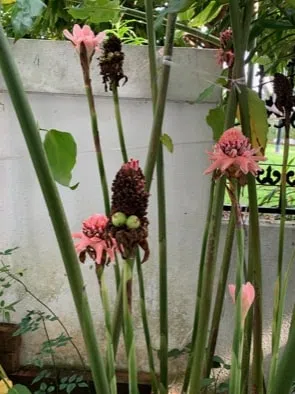
The torch ginger plant’s fruit are edible and reportedly can be eaten raw.
My torch ginger plant has fruited for the first time. Are the fruit edible?
Winifred Yap
The torch ginger plant is not toxic. Its fruit are edible and reportedly can be eaten raw, used in cooking or processed into sweets. They are used to make traditional medicine as well.
Desert rose lacks light and water

Although the desert rose is a drought-tolerant plant, it should not be left dry for too long.
I have had this plant for a couple of years, but the leaves always turn yellow and fall after a while, and the plant never flowers. I keep it by a north-facing window that does not get direct sunlight. What is wrong?
Serene Chan
Your desert rose (botanical name: Adenium obesum) is a sun-loving plant that may be in decline due to a lack of light and possibly water. This will cause the plant to produce long, lanky stems and eventually stop growing. Grow it in a spot which gets direct sunlight for at least six hours a day.
It could be shedding leaves due to the soil being too dry for extended periods. Although this plant is a drought-tolerant plant, it should not be left dry for too long. Water it thoroughly and let it dry out only slightly before watering again.
Papaya plant infected with incurable viral disease

Avoid growing other plants near papayas as they are susceptible to infestations.
What is wrong with my papaya tree? Its leaves are yellowing in patches and the new fruit are deformed.
Jacinta Tan
Your papaya plant looks to have been infected with a viral disease spread via sap-sucking pests such as aphids. These diseases are not curable and infected plants should be discarded, so avoid growing other plants near papayas as they are susceptible to such infestations.
Inspect plants regularly and take action promptly when pests are spotted. Wash infected plants with water and spray summer oil, matrine or diluted castile soap solution to control the pest population.
Dendrobium’s leaves are sunburnt

Put a shade cloth over the plant or move it back to a shadier spot for it to get used to the increase in light.
My dendrobium’s leaves have changed colour. What is wrong?
Adrian Ling
The yellow patches are a sign that the leaves are sunburnt, and the injuries are permanent. Did the plant grow in a shadier spot previously? While some dendrobium cultivars need good light to grow, they need to be slowly moved from a shadier location in order to acclimatise to higher light levels. Put a shade cloth over the plant or move it back to a shadier spot for it to get used to the increase in light.
Answers by Dr Wilson Wong, an NParks-certified practising horticulturist, parks manager and ISA-certified arborist. He is the founder of Green Culture Singapore and an adjunct assistant professor (Food Science & Technology) at the National University of Singapore.
Have a gardening query? E-mail it with clear, high-resolution pictures of at least 1MB, if any, and your full name to stlife@sph.com.sg. We reserve the right to edit and reject questions.
