
With SAM show Form Is Emptiness, Japanese artist Hiroshi Sugimoto finds peace
Sign up now: Get ST's newsletters delivered to your inbox

Hiroshi Sugimoto with his work. Brush Impression, Heart Sutra (2023).
PHOTO: SINGAPORE ART MUSEUM
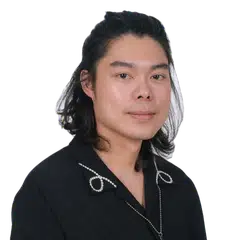
SINGAPORE – Internationally acclaimed artist Hiroshi Sugimoto needed to leave Japan to find his calling.
While studying photography at the ArtCenter College of Design in Los Angeles, United States, in the 1970s, the then 22-year-old found himself an unexpected ambassador of Asian wisdom, having to fend off repeated inquiries of “What is the enlightenment? Are you enlightened?”
He settled on a stock, slightly incredulous answer: “Of course I am. Are you?”
This was before he began to earnestly study the Buddhist text, The Heart Sutra, which has shaped his art practice for over 50 years.
“The Beatles went to India to understand Buddhism. That was the time of the Flower Power. I was among the flower children,” he says with some pride in fluent, American-accented English.
In Singapore for his biggest solo exhibition in Asia at the Singapore Art Museum (SAM), the 78-year-old is once more reminded of the penetrating insight an external point of view can bring to the familiar.
It was SAM chief executive Eugene Tan who persuaded him that his oeuvre was best presented through the prism of emptiness.
The SAM exhibition, which includes his works from nearly all his major series, is titled after Heart Sutra precept Form Is Emptiness. Presented in a mandala structure, it will run till Oct 4.
“This is something unique you need to be Asian, to be Oriental,” Sugimoto says of the organisational principle ahead of his show opening. “I’d never thought about doing this new style of conceptual curation. In Japan, Buddhism is cliche. People don’t pay serious attention.”
This coup by SAM – Form Is Emptiness is also Sugimoto’s first major retrospective in South-east Asia – has been many years in the making.
Japan’s National Museum of Modern Art in Tokyo is also hosting a major survey of Sugimoto from June 16. That will feature some 60 silver gelatin prints of his photography.
For scale, Hiroshi Sugimoto: Form Is Emptiness at SAM also comprises over 60 works, but expands beyond photos to sculpture, a video work and a 4.5m-high wall of his calligraphy of text from the Heart Sutra.
It also includes 14 of the artist’s fossil specimens, giving a sense of his serious investigation of nature, longue duree time and the ways they can be made visible.
Curator Angelica Ong says of the fossils’ inclusion: “The camera is able to isolate a moment whereas the fossils are an accumulation of time. Sometimes, when you’re lucky, you split the structure open and you get a 50-50 split where one side is the impression and the other side is the remains. It’s almost like the negative and positive in film photography.”

Curator Angelica Ong, Singapore Art Museum chief executive Eugene Tan and curator Amy Cheng. The Singapore Art Museum acquired Sugimoto's Tyrrhenian Sea, Scilla (1993) from his Seascapes series, on display at Hiroshi Sugimoto: Form Is Emptiness.
ST PHOTO: SARAH LEE
A philosophical approach
Born in 1948 in Tokyo, Sugimoto is a key figure in the elevation of photography to mainstay contemporary art.
His approach has been philosophical. His breakout series Dioramas, one of the first sections of the show, debuted in 1975 and comprises photos of dramatic wildlife scenes that on the surface look life-like, but were actually shot in the American Museum of Natural History.

Hiroshi Sugimoto’s breakout series was Dioramas (1975 to 1994).
PHOTO: SINGAPORE ART MUSEUM
This game with verisimilitude is again apparent in his Portraits series, begun in 1999. In these, historical figures from Henry VIII to Vladimir Lenin to Princess Diana appear to sit for him. In fact, they are figures from London’s Madame Tussauds wax museum, which itself modelled older figures after portraits by early modern painters like Hans Holbein the Younger and Jan van Eyck.
One gets the sense from speaking to Sugimoto that this approach stemmed from a keen awareness that photographers had to display a heightened conceptual strength to make it in an art world then still snobbish about the mediums that constituted art.
He says: “Photography is something that you give to your friend for free after taking a picture of him. Even with photographers who make abstract or surrealist photography, it was never respected as serious art.”
He adds of American surrealist Man Ray: “He was a great painter and made good, interesting sculptures, but because he took photographs, he was never valued. It took many, many years and I’ve spent almost my entire life to be considered as a first-class citizen of the art field.”
Sugimoto’s practice requires careful, meditative looking. The entire exhibition space is shrouded in darkness. Series like his optical glass pagodas, Five Elements (2011 to 2012), reward the visitor who peers closely into his spheres to reveal his famous photographs of seascapes from particular angles.

A visitor observing one of the nine optical glass pagodas in Hiroshi Sugimoto's Five Elements (2011 to 2012).
ST PHOTO: SARAH LEE
Another, In Praise Of Shadows (1998), documents the lifespan of flickering candles.
Most works are monochromatic, and seem to steer in the opposite direction of contemporary art at the recent Venice Biennale, where national pavilions courted controversy and vied to be loudest – in step with the political protests that broke out sporadically across the venue.
To this provocation, Sugimoto simply says: “Art should cover a more general and philosophical view of the world. The sea of emptiness doesn’t make understanding of the issue dependent on gender or political stance.”
Then he adds, like a man wearied of the world: “I don’t want to be invited to the Venice Biennale anymore.”

Hiroshi Sugimoto's In Praise Of Shadows (1998) series.
ST PHOTO: SARAH LEE
Yet, in recalling his own trajectory, Sugimoto concedes that his success cannot be discussed separately from political superstructures.
The climate in 1970s New York was generous enough to enable him as an immigrant to pitch himself into the scene “like a gambler”. The Guggenheim Fellowship gave the then self-confessed “unknown Japanese boy” a US$15,000 cheque. The National Endowment for the Arts also gifted him a fellowship in the thousands at a time when rent was just US$125 a month.
“Now, the situation has changed. (United States President Donald) Trump has cut funding. It’s no longer a nice, welcoming space.”
A medium with longevity
His preference for black-and-white photos may have started from a search for timelessness, but it is also pragmatic. Coloured prints tend to fade, but black-and-white prints with the proper archival processes stay fresh for over a century.
Recent advancements in C-print technology have allowed photos to retain their colour much better. So, he also started a new series, Opticks, in 2018 that split colours with a prism and focused on the “intracolours” between more distinct colour bands.
“It’s not necessary anymore that Sugimoto does only black-and-white,” the playful artist jokes. “I betrayed myself.”
In his five decades of work, Sugimoto has kept one project steadfast: his most famous series of Seascapes, in which he photographs the meeting point of sky and sea that he first successfully captured of the Caribbean Sea in 1980. He has since shot similar seascapes with long exposure, sometimes over hours, at more than 250 locations worldwide.

Hiroshi Sugimoto's Seascapes (1980 to present) series at Hiroshi Sugimoto: Form Is Emptiness.
ST PHOTO: SARAH LEE
The impetus is again for eternity and timelessness, which propel so much of his work.
He says: “I asked myself, ‘What would be the same vision we can share with ancient people who lived in even the Stone Age?’ That’s maybe the sea. Everything on the ground we have destroyed and changed.”
The irony is that he can now no longer document these vistas. After the 9/11 attacks, tightened airport security means he can no longer transport fresh prints without putting them through damaging X-ray scans.
Still, every Jan 1 in Japan, he makes it a point to be at a special viewing deck – not open to the public, he emphasises – to capture a rare quiet sea finally emptied of fishing boats and commercial ships.
His five decades of wrestling with time – wanting to distil its fixity even as the world shifts unforgivingly – culminates improbably in this show at SAM.
Relaxed, Sugimoto’s reaction is as much courteous as it feels genuine: “This SAM retrospective is proof that my ambition to push photography up is completed. I’m ready to go.”
Book It/Hiroshi Sugimoto: Form Is Emptiness
Where: Singapore Art Museum at Tanjong Pagar Distripark, 39 Keppel Road
MRT: Tanjong Pagar
When: Till Oct 4, 10am to 7pm daily
Admission: $20 ($15 for Singaporeans and permanent residents)
Info: bit.ly/SAMHiroshiSugimoto