
‘We did not expect to have so much to learn from Singapore’: Historian Wang Gungwu in new memoir
Sign up now: Get ST's newsletters delivered to your inbox

Professor Wang Gungwu's new memoir offers insights into the star academic's life and why he chose to stay in Singapore.
ST PHOTO: GIN TAY
Wang Gungwu
SINGAPORE – The following is an edited excerpt from 95-year-old Australian historian Wang Gungwu’s recently published memoir No Borders: Journeys Across Islands And Continents (2026), reproduced with the permission of publisher World Scientific.
Margaret and I had no plans to stay in Singapore for more than a few years. We had found some relief after the tensions of Hong Kong, but, more unexpectedly, we watched the changes in Australian politics with considerable dismay. There was now the perception that the country had become the “US deputy sheriff” in Asia, while American strategists identified the People’s Republic of China (PRC) as a potential threat to their country’s interests. Viewing developments from my offices in the Institute of Southeast Asian Studies (ISEAS) and the East Asian Institute (EAI), I realised that I had underestimated those changes during my years in Hong Kong.
Nevertheless, we did not expect to have so much to learn from Singapore’s perspective. This was something new and the longer we stayed, we found that the more there was to learn. I began to understand why its best interests rested with a balanced approach towards both the US and PRC, and with carefully controlled support for each country. Singapore was consistent in its new investment and trading relationships with China, and their well-established defence and diplomatic ties with the West seemed to have satisfied its neighbours.
We found this encouraging. I was first appointed on short contracts and we were ready to move back to Australia at a moment’s notice. This did not affect the way we settled comfortably in our first apartment in Ardmore Park. Our stay became even more enjoyable when our son Ming and his family moved to Singapore for a few years. In 2008, we moved to Setia Residences in Novena. My university appointment was extended with a longer contract and our circle of friends had widened considerably by then. I must confess that we became content to stay longer and provide our family with a pied-a-terre for their regular visits.
My EAI work helped me learn more not only about China’s capacity to absorb everything they wanted to catch up with the dominant West, but also about the post-Cold War order that enabled Asian economies to take off beyond expectations. In turn, that led me to be more curious about the historical relations between the Mediterranean powers and those of continental and maritime Asia.
All this added to my appreciation of the cultural factors underlying the political and economic contests that transformed the world over millennia. It soon became clear that Singapore’s central location in a newly identified region between two oceans had provided me with perspectives concerning the impact of liberal globalisation that neither Canberra nor Hong Kong could have done.
This was something that did not merely give me new imaginings of home for us as a family. Singapore, as a global city, had gifted me something unexpected: an observation base to re-examine how the past and the present might be interacting in the world today. For example, was the ancient Holy Roman Empire finally reunited in the North Atlantic to rule the world across the oceans? Were the fall of dynastic China and the revolutions that followed the catalysts for a modern Chinese multi-national party state that combined continental power with maritime outreach?
I had not offered answers to such questions, but wanted to point out what inspired me to ask them. This was when I found myself operating within an orderly environment in which neither critical liberalism nor authoritarian control prevailed. A kind of realist empiricism that was cultivated to allow an island-state to survive had shaped a broader national outlook that has been absorbed into the governance system. It had become a truly meaningful home to the millions who swore to die for it. Margaret and I found it remarkable how the Singapore we knew in the 1950s could be so transformed and why we could be comfortable enough to stay on for so long.
----
As it turned out, Margaret got used to treating the city-state as home till 2020, when she passed on. I am still there, at the time of writing this book, in 2025. Singapore represented a kind of mixed social order that had official borders, but could behave as if it had none. In a strange way, this acted as a mirror of our lives, in which family marked some soft borders, but work and place seemed never to have had any.
Looking back, this was not surprising. Both of us seemed to have started our lives that way. Margaret was born in Shanghai to parents from Keelong in Taiwan and Shaowu in northern Fujian, who came to live in Penang and Singapore with no family, clan or dialect connections of any kind. I was born in Surabaya and moved to Ipoh, and my parents, who were from Jiangsu, north of the Yangtze, were similarly unconnected with any of the families or communities in the Dutch East Indies or British Malaya. It was also true of the few Chinese families living in Canberra who came from Hong Kong, Jiangsu, Guangzhou, Shandong, Zhejiang and Fujian. There were not enough of us to even think of forming a Chinese association.
In Singapore, we identified as Chinese in our own different “imagined” and un-bordered ways. As a result, while we respected those who felt that they were truly local and belonged, we were habitual non-joiners when it came to identity-based organisations. We were most comfortable with informal social groups among whom we enjoyed being with; it did not matter if they were global or local at the same time.
At 90, when I had to learn to live without Margaret, memories of loving wherever we were, because we were together, kept everything normal. Except for one year, when I was studying history in an ancient city (London) and she was in Singapore and we were aerogrammes apart, we always lived in the same place. Therein, I recall times when we did not do what we should have done, and other times when we did what we should not have done. We found Kuala Lumpur, Canberra and Hong Kong were all ambitious cities to be part of, each reaching as high as it could, but none was satisfied that it was high enough.
Returning to Singapore, we encountered a separated port that had bravely confronted all its fears and found its own distinctive road to safety. We loved its orchids, its creative voices, its open doors to multiple gods of opportunity. Everything we saw was made to be carriers of hope. Even when Margaret’s light dimmed in the glare of a world order that had shifted to threats and boasts, and when pandemics ruled the days, we knew that we would meet again.
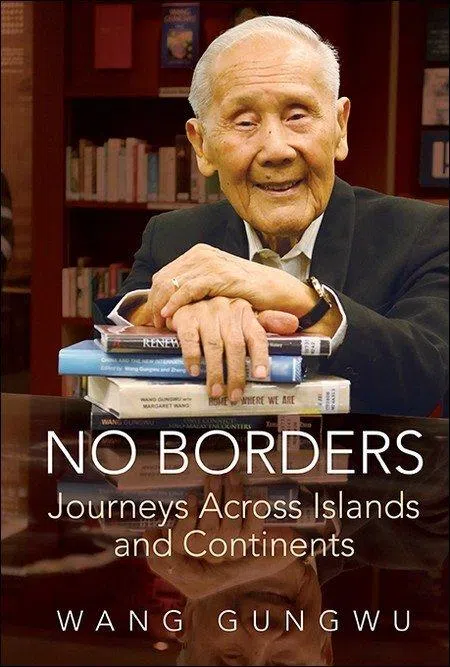
No Borders: Journeys Across Islands And Continents by Wang Gungwu.
PHOTO: WORLD SCIENTIFIC
Professor Wang Gungwu spent the last 30 years in Singapore but has lived variously in Malaya, London, Australia and Hong Kong, where he was vice-chancellor of the University of Hong Kong from 1986 to 1995. No Borders: Journeys Across Islands And Continents (World Scientific, 2026, $36) is available on the World Scientific website and in major bookstores.
