
The Straits Times Life Theatre Awards 2026
Serangoon Gardens Techno Party sweeps major prizes, Coco Wang Ling is Best Actress
Sign up now: Get ST's newsletters delivered to your inbox

(Clockwise from top left) Coco Wang Ling, Ramesh Meyyappan, Chong Tze Chien and SRT’s Macbeth.
PHOTOS: KEVIN LIM, SRT
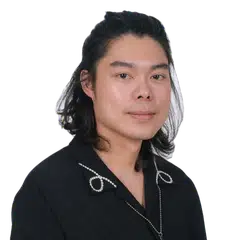
SINGAPORE – The team behind Wild Rice’s rave of a play, The Serangoon Gardens Techno Party Of 1993, can keep the party going in 2026.
It emerged the grand winner at the 25th edition of The Straits Times Life Theatre Awards as it swept four prizes for Production of the Year, Best Original Script, Best Actress and Best Supporting Actor.
Directed by Sim Yan Ying and written by Wild Rice’s artist-in-residence Joel Tan, Serangoon Gardens elicited some fervent responses from audiences during its run, first for its subject – a paean to naughtiness and teenage rebellion in straitlaced Singapore – then later for its raw, adrenaline-fuelled execution.
In less than two hours, it delivered a breathy, pacey narrative that channelled irrepressible angst as the unstoppable tidal wave wrecking all in its path.
Judges ST arts editor Ong Sor Fern, correspondent Clement Yong and journalist Shawn Hoo rewarded it in four of the six categories it was nominated in, making it the most prolific winner of this milestone 25th edition.
Ms Ong, who helped conceptualise the ST Life Theatre Awards in 2001, said: “The judges were fairly unanimous when it came to the winners in the big categories. Serangoon Gardens was a clear winner in multiple categories. Joel Tan’s sharply observed script and characters were backed up by a strong cast and the work’s all-round strengths made it the front runner for Production of the Year.”
Winners have their say
The play’s director Sim, 30, said the four awards for Serangoon Gardens proved a desire for works that were loud, messy and brazen. She was nominated for Best Director, but lost in the category to veteran Chong Tze Chien.
The debut nominee said: “It is testament to the collective courage it took to make something this unruly. The willingness to take creative risks, to experiment in bold and thoughtful ways, and to trust that there is space and appetite for this kind of theatre in Singapore.”
Playwright Tan, 38, clinched his second Best Original Script in three years after his 2024 triumph for culture war satire G*d Is A Woman, and credited his creative team for the win.
“I really feel this was a collaboratively written project with the cast, the director and the designers. There are a lot of formal gestures in this play that I discovered only while writing it, and working on it with my amazing collaborators taught me a lot about making theatre.”
The appreciation for Coco Wang Ling, 26, in her breakout role as fiery 16-year-old Candice, was rapturous. She was described in ST’s review then as magnetic – “spiky as a porcupine but also coquettish and almost blushing at will, an expert in taunting-pleading and all-knowing side eyes”. Each night was a test of stamina for the actress who runs non-stop on stage.

Coco Wang Ling won the Best Actress prize at The Straits Times Life Theatre Awards 2026 for her role in The Serangoon Gardens Techno Party Of 1993.
ST PHOTO: KEVIN LIM
Wang said each performance was a rebirth, a shedding of pent-up energy, particularly with the strings of swear words she got to shout at the top of her lungs, “and be paid for it”.
The success of Candice was mentally freeing for the young actress. “At the beginning, I felt that this was an impossible task. But after doing it, I’ve learnt I shouldn’t be the one limiting myself. I’m not going to decide for myself whether I can or cannot do certain things. I’ll just go for it. I’ll let the industry limit me.”
Best Actor went to Ramesh Meyyappan for his wordless portrayal of Shakespeare’s King Lear in Raw Material’s Singapore International Festival of Arts (Sifa) production Lear, which also beat the competition in the Best Lighting category.

Best Actor Ramesh Meyyappan took on the role of Lear without the help of Shakespeare’s language.
ST PHOTO: KUA CHEE SIONG
In the performance at School of the Arts’ Studio Theatre, King Lear is not king but a deaf war veteran making a tentative return home to his three daughters.
Meyyappan, who is deaf, channels the self-hating anguish of Lear without help from Shakespeare’s language, gesturing agitatedly as he cowers from the whistling of aerial bombs and as black confetti rains down on stage.
The Glasgow-based veteran thanked then Sifa director Natalie Hennedige for trusting him enough to commission the unusual work, and admitted: “Having an absence in Singapore makes it daunting to come back. I’m not sure if audiences will remember me or will resent my absence.
“I’ve only really begun to play older roles and I’m still exploring how to do this as someone who relies on a visual and physical aesthetic as my theatrical language.”
He has won Best Actor twice, in 2008 and 2012, and now completes his hat-trick.
The actor acknowledged the violence of the world today. “When we were working on Lear, the war in Ukraine was ongoing and the conflict in Gaza was unfolding. Much of what was happening – the scale of suffering, the loss of life and the destruction – was, and still is, difficult to comprehend.
“Performing in Lear only heightened my understanding of the damage that conflicts can do to us as individuals and as communities.”
Wang’s counterpart Teoh Jun Vinh, 32, won his first Best Supporting Actor award as humiliated and pure-of-heart Jun Hao. It was his second consecutive year nominated in the category after his hilarious turn as a mathematics teacher in Checkpoint Theatre’s Secondary: The Musical – a role he reprised in a rerun in 2026.
He brought his trademark deadpan humour and also supplied the nihilistic Serangoon Gardens with a tender moral core. He said his silliness was partly honed through the “razor-sharp, often absurd comedy of Japanese manga”, but added that he was first and foremost a character actor.
Teoh also devoted a part of his winning remarks to society’s embracing of artificial intelligence: “The recent trend of AI replacing creatives is a sustained wound to many incredible local artists, and I hope people understand that if you replace human ingenuity, you will see a sharp decline in quality.”
Actress Rusydina Afiqah, who was nominated twice in 2026 in the Best Supporting Actress category for her roles in Salina and Statement Piece, won for the latter for playing Marjia, the artist-girlfriend of beleaguered curator Lily.
The Checkpoint Theatre play debated the exhibition of a piece of shocking art, and Rusydina was one in a trio comprising Tricia Tan’s powerhouse gallerist Lily and actor Huzir Sulaiman’s disgruntled artist Gopal Rangaraj. But she made an outsized impact and retained her own gravitational field against the moody Rangaraj.
ST’s review said of Rusydina’s character: “Marjia gives as good as she gets... Huzir’s deadpan aplomb contrasts with Rusydina’s motormouth enthusiasm for some very funny moments”.
The actress, 32, says of her dual nominations: “It feels very humbling. It reminds me to trust the process and the work because a lot of what we do as actors happens quietly in rehearsal rooms.”
Sight Lines’ adaptation of British-Irish playwright Martin McDonagh’s The Pillowman (2003) was the dark horse. Its run was relatively quiet, but a boldly fractured interpretation of the psycho-drama helped secure Best Director for Chong Tze Chien and Best Ensemble for the all-male cast of Irsyad Dawood, Jamil Schulze, Joshua Lim, Krish Natarajan, Lian Sutton and Shrey Bhargava.
Chong, 50, had all six actors shape-shift to play both perpetrator and victim, each bringing his own emphasis to the character of violent short-story writer Katurian Katurian. It was a timely re-read of the classic through the contemporary lens of fraying masculinity.

Chong Tze Chien is Best Director for his complex work on The Pillowman.
ST PHOTO: GAVIN FOO
In his victory remarks, Chong said there was initial confusion even among the actors at his vision. “It felt a bit like being told to solve a puzzle without seeing the picture on the box. The shift happened in the first rehearsal when I staged the entire first act with a rough mock-up – mirrors, slits, hidden entrances and exits. By the end, they weren’t just convinced, they owned it. I must thank them for trusting me.”
Setting the stage for wins
Singapore Repertory Theatre’s blockbuster production Macbeth, which played outdoors at Fort Canning Park, took home its by-now customary Best Set and Best Costume awards – two categories it also clinched in 2024 with its A Midsummer Night’s Dream.
The Dune-like spectacle of Macbeth boasted more than 200 rust red columns, with some rising to 14m, and rubber mulch that actors could kick up like desert dust. A dagger appeared integral to Macbeth’s crown. The consistency in the dramatic world-building had much to do with Richard Kent, who was behind both costume and set designs.

SRT’s Macbeth at Fort Canning Park.
PHOTO: SRT
Kent said meticulous attention was paid to the hierarchy of costumes, with the leather belts of lords embossed with clan emblems. Uniforms took inspiration from Asian cultures, including samurai and anime subcultures.
He added of the secret to a successful Shakespeare In The Park set: “It is to create a space that has the ability to hold smaller scenes that focuses the audiences’ attention in intimate moments but can then be scaled up for big set pieces and spectacle.
“The scale of the production is part of the draw for the audience and so creating that wow factor rooted in the themes of the show is a major part of the design process.”
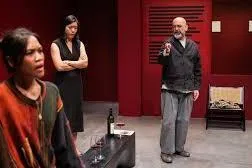
Rusydina Afiqah (left) holds her own against leads Tricia Tan and Huzir Sulaiman in Statement Piece.
PHOTO: CHECKPOINT THEATRE
The new category of Best Music went by a landslide to Sifa live concept album Stray Gods by composer weish, whose Secondary: The Musical was Production of the Year at the awards in 2025.
The performer, whose theatre star has been fast rising in recent years, confessed to some early anxiety that her elemental blend of Hakka music and Greek tragedy at times resembling a hillside amphitheatre party disrespected tradition.
“I asked myself if I had the right to sing in Hakka when I had no real lived experience of my Hakka-ness. But while I am Hakka, I am also a child of modernisation, multiculturalism and colonisation.
“The work genuinely reflects my yearning for and reconnection to culture. I’d like to think my ancestors would still see a part of themselves, or an extension of themselves in the work.”

Stray Gods, a live concept album by musician weish.
PHOTO: MOONRISE STUDIO
Brian Gothong Tan won Best Multimedia for his work on World War II drama A Thousand Stitches, which incorporated live cinema elements and historical cartoons into its staging.
Best Sound was won by Nine Years Theatre’s meta-theatre play Waiting For Audience – its only conversion from its six nominations. Judges awarded sound designer Ng Jing for his porous use of ambient noise as two actors struggle for supremacy in an old theatre.
Ng said: “It was an interesting journey finding the right hums, clinks and rattles to help form the dynamism of its ‘voice’. Not only did the sound effects aim to echo the emptiness of the theatre and respond to the performers, but I also chose to play them from different directions and corners of the theatre in order to draw the audience into the vastness of the space.”

Nelson Chia and Mia Chee were both nominated for Best Actor and Best Actress for Waiting For Audience. The show converted one of its six nominations.
ST PHOTO: KEVIN LIM
Ms Ong said the awards demonstrated the diversity of talents on the scene, and added: “Given how far the theatre scene has come in 26 years of the awards, I look forward to seeing how it will evolve in the future.”
Full list of winners
Production of the Year: The Serangoon Gardens Techno Party Of 1993, Wild Rice
Best Actor: Ramesh Meyyappan, Lear
Best Actress: Coco Wang Ling, The Serangoon Gardens Techno Party Of 1993
Best Supporting Actor: Teoh Jun Vinh, The Serangoon Gardens Techno Party Of 1993
Best Supporting Actress: Rusydina Afiqah, Statement Piece
Best Director: Chong Tze Chien, The Pillowman
Best Ensemble: The Pillowman
Best Costume: Richard Kent, Macbeth
Best Sound: Ng Jing, Waiting For Audience
Best Music: weish, Stray Gods
Best Set: Richard Kent, Macbeth
Best Original Script: Joel Tan, The Serangoon Gardens Techno Party Of 1993
Best Multimedia: Brian Gothong Tan, A Thousand Stitches
Best Lighting: Derek Anderson, Lear