
Persepolis, Shah Of Shahs and The Rubaiyat: 7 books to read about Iran’s culture and history
Sign up now: Get ST's newsletters delivered to your inbox

(Clockwise from top left) Persepolis books one and two by Marjane Satrapi, My Uncle Napoloen by Iraj Pezeshkzad, Shah Of Shahs by Ryszard Kapuscinski, The Rubaiyat Of Omar Khayyam by Edward FitzGerald, Black Wave by Kim Ghattas, Martyr! by Kaveh Akbar and Salt, Fat, Acid, Heat (2017) by Samin Nosrat.
PHOTOS: PANTHEON BOOKS, MAGE PUBLISHERS, PENGUIN BOOKS, PANTIANOS CLASSICS, HENRY HOLT AND CO., ALFRED A. KNOPF, SIMON & SCHUSTER


Follow our live coverage here.
SINGAPORE – The United States and Israel’s bombardment campaign against Iran that now threatens to spill out of the region is the latest turn in the unfortunate modern history of the Middle East.
As with the tendency on such occasions, the focus has been on a now-decapitated regime cast as an intransigent, nuclear-hungry theocracy. Yet this is also one of the world’s oldest continuous civilisations. The Cyrus Cylinder of the Achaemenid Empire is the earliest human rights charter, when, upon the capture of Babylon in 600BC, it declared that King Cyrus the Great “freed its citizens from the yoke of servitude (and) set them free to worship their gods whose abodes I raised from ruins”.
In popular culture, the mystic writings of Rumi and the poetry of Hafez are some of the most quotable on social media. Nor does Iran revel only in past glories: 2025’s Palme d’Or at the Cannes Film Festival was won by Iranian film-maker Jafar Panahi for his revenge dark comedy, It Was Just An Accident.
The Straits Times selects seven books, both fiction and non-fiction, for those wanting a foothold in Iranian culture. They skew towards the recent, but hopefully give a sense of the spirit that has flourished in a millennia-old cultural powerhouse.
1. Persepolis (2003 and 2004) by Marjane Satrapi
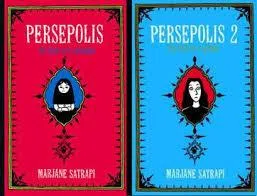
Persepolis books one and two by Marjane Satrapi.
PHOTO: PANTHEON BOOKS
There can be no Iran booklist without Persepolis. This graphic novel duology by Iranian-French author Marjane Satrapi of a headstrong girl growing up in 1970s Iran manages to be both unique and generalisable, with a traumatic betrayal at its heart.
With her simple black-and-white illustrations, Satrapi returns readers to the misplaced thrill of secular leftists when the Shah was toppled in the popular 1979 Iranian Revolution. The Shah – who had himself been installed by a Western-backed coup earlier – was succeeded by the Islamic Republic, of which the recently killed Ayatollah Ali Khamenei was the second supreme leader. History repeats itself in another key.
Satrapi’s protagonist, also named Marjane, is half-knowing witness to this regime change. Like her mother and grandmother, she learns the degrees of misogyny brutally enforced by the morality police in Iran, but that is also accepted as de rigueur in Austria, where she is sent to school.
These phenomenally engaging vignettes were translated into an animated film in 2007, co-directed by Satrapi and retaining her distinctive art style.
2. My Uncle Napoleon (1996) by Iraj Pezeshkzad

My Uncle Napoleon by Iraj Pezeshkzad, translated by Dick Davis.
PHOTO: MAGE PUBLISHERS
First written in Persian in 1973, Pezeshkzad’s tale leans into farce for a satirical diagnosis of the Iranian psyche. A tyrannical head of a households fancies himself Napoleon, seeing everywhere a British plot to take him down.
From the beginning, his paranoia is seen to mirror those of Iran’s political elites, though this was before the United States replaced the British as The Great Satan.
But this portrait is also comic family and community drama, in the way that Colombian writer Gabriel Garcia Marquez’s One Hundred Years Of Solitude (1967) finds the sprawling, eccentric family the best vehicle for social commentary. The narrator offers the possibility of a different future: the innocent 13-year-old nephew of “Napoleon”, falling in love and discovering sex.
A faithful 1976 television adaptation is available, so popular at its acme that its lines entered Iranian common speech.
3. Shah Of Shahs (1982) by Ryszard Kapuscinski

Shah Of Shahs by Ryszard Kapuscinski.
PHOTO: PENGUIN BOOKS
A seminal history text for those who know that truth is stranger than fiction. Polish journalist Ryszard Kapuscinski, who in his lifetime witnessed 27 revolutions, chronicles the downfall of the Pahlavi dynasty as an inevitable event from the Iranian streets.
Then a foreign correspondent for the Communist Polish Press Agency, he wraps this disorienting experience and a flurry of reportage up with a bow and tie in a miraculous 152 pages. His literary style, mixing in allegory, led US author Adam Hochschild to knight his writing “magic journalism”.
See this final paragraph for a flavour. After the dust settles, a merchant tells him of the possibility of escape through the beauty of Iranian carpets: “Then you can continue imagining the fragrance of the garden, you can listen to the murmur of the stream and the song of the birds. And you feel whole, you feel eminent, you are near paradise, you are a poet.”
4. The Rubaiyat Of Omar Khayyam (1859) translated by Edward FitzGerald

The Rubaiyat Of Omar Khayyam translated by Edward FitzGerald.
PHOTO: PANTIANOS CLASSICS
The hedonistic quatrains of 11th-century Persian polymath Omar Khayyam are available to English readers today through the completely unfaithful translation of Victorian poet Edward FitzGerald.
But the wit and iconoclasm of Khayyam, whose verses ridicule religious belief while exhorting the necessities of booze – “Am I a wine-bibber? What if I am?” – will still bring to anyone’s lips a chuckle and reinspire in their minds a critical defiance.
FitzGerald’s translation, after laying largely unnoticed for two years, suddenly took Victorian society by storm, and was said to be as influential as Charles Darwin’s On The Origin Of Species, published in the same year.
It is an entirely different image of Iran, earning the allegiance of Dante Gabriel Rossetti, Oscar Wilde and John Ruskin. An hour is more than enough to get through it, though its spirit will stir you to mischief long after.
5. Black Wave (2020) by Kim Ghattas
Black Wave by Kim Ghattas.
PHOTO: HENRY HOLT AND CO
A more regional history, again centred on the decisive year of 1979, but this time placing it in the context of a fundamentalist siege on Mecca and the Soviet invasion of Afghanistan in the same year.
Lebanese journalist Kim Ghattas argues that these superficially unconnected events reshaped the Middle East. Her readable account begins with civil war in Lebanon in 1977 and ends with the murder of Saudi journalist Jamal Khashoggi in Istanbul in 2018, but her narrative radiates outwards: to the rise of the Islamic state, the failed Arab Spring, the fatwa against Indian-British novelist Salman Rushdie and the sudden increase in veil wearing among women.
Her history prioritises the agency of Tehran and Riyadh, and the exploitation of religion by dictators, pushing the Arab-Israeli conflict and American involvement somewhat to the wayside.
It is another way of looking at the longer-term responsibility and the capacity for self-determination in the Middle East, despite US and Israeli actions today making it appear otherwise.
6. Martyr! (2024) by Kaveh Akbar
Martyr! by Kaveh Akbar.
PHOTO: ALFRED A. KNOPF
Iranian-American poet Kaveh Akbar’s debut novel takes the perspective of a tired young man fixated on martyrdom, though not the religious kind – “Secular, pacifist martyrs. People who gave their lives to something larger than themselves.”
To stave off this death impulse, he writes a book on historical martyrs including Indian anti-colonial revolutionary Bhagat Singh and famous Chinese poet Qu Yuan. The violence of the past intrudes everywhere: His mother died in a plane mistakenly shot down by the US Navy in the final months of the Iran-Iraq war in 1988.
Akbar’s very contemporary novel is particularly good in its exploration of how the world and politics can osmose into a young boy’s psyche to supercharge those immemorial themes of human damage: existential dread, grief, addiction and helplessness.
This is a melodramatic ride, referencing everything from Rumi to Lisa Simpson.
7. Salt, Fat, Acid, Heat (2017) by Samin Nosrat
Salt, Fat, Acid, Heat (2017) by Samin Nosrat.
PHOTO: SIMON & SCHUSTER
Need something lighter? Samin Nosrat’s award-winning cookbook reproposes four cardinal points of cooking, passing on her revelations after 16 years in the kitchen to beginner chefs.
Born in San Diego in 1979, Nosrat had never been to Iran, but her mother made sure to infuse Iranian heritage into their meals. They would gather each night round the table with aunts, uncles and grandparents to eat heaps of saffron rice, stew, herbs and yogurt.
Her story is one of an Iranian diaspora that is cosmopolitan and need not be confined by politics. A 2018 documentary after popular reception to her book took her to Japan for salt, Italy for fat, Mexico for acid and home to Berkeley, US, for heat.
