
Year of the Horse stars
No horsing about: Turning 84, artist Wong Keen continues to upset bourgeois taste
Sign up now: Get ST's newsletters delivered to your inbox

Artist Wong Keen and his painting The Source Of Supper in artcommune gallery at Carlton Hotel Singapore.
ST PHOTO: LIM YAOHUI
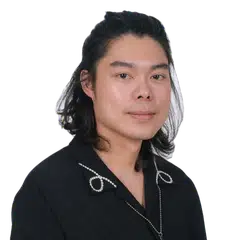

Born: Nov 23, 1942
Wong Keen is reclined on a couch, his arms crossed lackadaisically behind his head. Next to him, flesh carcasses stream down off invisible hooks. They are bloody and tightly packed, striations telling of ribs and stretched sinews.
The 2m by 3m expressionist painting, titled The Source Of Supper, has been picked to serve as backdrop to this article for its accents of red – in time to celebrate the 83-year-old born in the Year of the Horse in 1942, seven Chinese zodiac cycles ago.
At artcommune gallery in Carlton Hotel Singapore, Wong is quick to emphasise “I don’t believe in all that”, before relating a morbid thought experiment of vanishing planes.
“Millions of people were born in the Year of the Horse, but do they really share the same fate? The only way is to work hard and achieve something, regardless of circumstances. A piece of bread is there: If you don’t try to get it, somebody else will.”
Hustling in New York
Wong’s hardscrabble attitude is driven primarily by his formative years pursuing art studies in the United States – the first Singaporean to be accepted to the prestigious Art Students League of New York in the 1960s.

Wong Keen (left) with his teacher, gibbons painter Chen Wen Hsi, before he departs for New York.
PHOTO: COURTESY OF WONG KEEN
Initially aiming for Paris – he had already studied some French – he was persuaded to head to the Big Apple, financing the trip with a sold-out exhibition at the National Library in Stamford Road, facilitated by art teacher Chen Wen Hsi.
Just 19 years old, he hustled. It was a way of life that suited him and was part of the city’s magic, as he revelled in odd jobs from carpentry to restaurant and hotel work. For about 25 years, he ran a booming business making frames and opened a gallery.
He ran in a clique with Chinese artist Ai Weiwei and Taiwanese painter Ching-Jang Yao, and met American luminaries such as minimalist Sol LeWitt – who bought Wong’s work – and watercolourist Dong Kingman, for whom Wong sometimes ran errands.

Wong Keen mailed this photograph to his family in Singapore, writing on the obverse: “In the absence of anything more I can send back home, this will have to do.”
PHOTO: COURTESY OF WONG KEEN
Wong, married with four children, still straddles Singapore and the US. With some prodding, it is clear this six-decade uprooting set him on a divergent path from other home-grown artists.
For one thing, he is hawking meat in artcommune gallery, where his works have been placed in dialogue with those of Taiwanese artists. He asks: “Who wants to hang a piece of meat in the house?”
Well aware of the preference of local collectors for still-life works and nostalgic street scenes, he laments the shortage of Singapore artists working on the historically fertile motifs of the flesh and the nude.
He adds pointedly: “An artist told me he likes my work a lot, but says ‘I cannot do what you do, because I’ll lose my market.’
“You can’t give up because people don’t accept you. I hang on to it, and still try to do something beautiful that can be accepted.”
Wong was first viscerally attracted to these carcasses and the “rhythm of the ribs” during a residency in Beijing in 2012, but has since come to wield it as a bloody critique of consumerism. Before that, he had made a name for himself painting more palatably abstract lotus flowers and urban scenes, including of monumental samsui women.
Private art salon The Culture Story, founded by father-daughter duo Chong Huai Seng and Ning Chong, and artcommune gallery gave his vision its fullest platform with a solo in 2018 – Wong Keen: Flesh Matters.
This introduced visitors to his explicit but playful visions of meat stands, as well as the delicious human-size burgers that were the ultimate pop symbol struggling to contain his vigorous brushstrokes and delicate “drip and flow” technique.

Wong Keen’s A Good Bite, 2024.
PHOTO: ARTCOMMUNE GALLERY
10 to 20 paintings a day
Wong seemed able to constantly reinvent the motif – with and without fries, or even cartoonishly, as a car on the highway.
Alert to the exploitation of women, he sandwiched nudes within the meat columns of his meat stands and semi-abstractedly as burger patties.
Wong says prostitution in the US affected him deeply and shaped his thinking. “I’m not so much about politics, but about the conduct of humans towards humans. Why I’ve become that way is also through observation, through experience, immediate family members who have suffered from this sort of inequality.”
Unlike more insular Singapore contemporaries, his art directly confronts the tragedies of the world. A 6m mural laments the 2011 Syrian civil war. And, in The Flight (After Pieter Aertsen, 1551), he reinterprets a 1551 Dutch still life by substituting a background narrative of Mary and Jesus’ flight to Egypt with a refugee boat.
“Most artists don’t have the guts to paint like that,” he says.

The Flight (After Pieter Aertsen, 1551), 2021, acrylic on canvas, 218.5cm by 274cm.
PHOTO: ARTCOMMUNE GALLERY
He adds in summation with almost Buddhist Zen: “A lot of things happened. Good things, bad things. Nothing made me rich. Nothing made me poor. It’s an interesting life.”
Still healthy, Wong today spends most of his time doing “serious painting” in his Sembawang studio after walking to Kopitiam Corner nearby for breakfast. When caught in the riptide of a productive mood, he charges through 10 to 20 small paintings a day.
The devotee to the complete autonomy of the artist nevertheless believes that Singapore needs more art critics to make the next leap. He is working on a series of more colourful drawings that will be in the same vein as his earlier Picture Writing series of black-and-white nudes.

Wong Keen painting in his studio, in front of sculptures of carcasses he moulded out of rice paper.
PHOTO: S.E.A. FOCUS
On critics’ positioning of his style as a blend of Chinese ink techniques and Western abstract expressionism, he shrugs: “I have always painted fast and worked fast – huge paintings, powerful, big strokes, quick and suggestive.”
The only thing that matters in the Year of the Horse is that the reins are still his to take.
“Some artists keep doing what sells. For me, it’s repetitious. I like to venture. No matter what I do, my handwriting remains.”
