
Five things to see at ArtScience Museum’s Flesh And Bones exhibition
Sign up now: Get ST's newsletters delivered to your inbox

Flesh And Bones: The Art Of Anatomy opens on March 21.
PHOTOS: COURTESY OF ARTSCIENCE MUSEUM, GIN TAY, JASEL POH
SINGAPORE – The ArtScience Museum’s new exhibition features 160 artefacts and artworks to do with the body, from historical anatomical drawings to a preserved head.
Flesh And Bones: The Art Of Anatomy opens on March 21. Here are five things not to miss.
1. Life-size Cattani figures

18th-century ecorche figures by Antonio Cattani hang next to drawings by Hong Kong artist Angela Su.
ST PHOTO: GIN TAY
Recently acquired by Los Angeles art centre Getty Research Institute, these three 18th-century studies of male bodies are among a handful in the world – impactful for their sheer size and exactitude of detail.
They are ecorche figures, which means their skins have been removed to reveal the underlying flexed muscles. Printmaker Antonio Cattani in the 18th century has captured them beautifully in etching and engraving.
At the time, they could be bought by medical students and artists, part of a trend then of full-scale representations of the human body.
This trio are modelled after the wood figures supporting the lecturer chair’s canopy in the University of Bologna’s anatomical theatre. Lectures were held there as well as dissections of animals and humans.
2. Singapore artists

The charcoal drawings of late artist Solamalay Namasivayam.
ST PHOTO: GIN TAY
The Getty loans’ more flashy counterparts in the exhibition are contemporary artworks from all over the world, including those by five Singaporeans. Look out for the tightly cropped figures in the late Solamalay Namasivayam’s charcoal drawings. He was one of the pioneers of life drawing at a time when it was still taboo.
Yanyun Chen’s gold-leaf keloid scars glint with quiet dignity in her nude partial portraits. Woong Soak Teng assembles X-ray scans from her scoliosis treatment and also photographs others with similar curvatures of the spine in their bedrooms.

The keloid scars in Yanyun Chen’s nude partial portraits glint with quiet dignity.
ST PHOTO: GIN TAY
Singapore’s 2026 Venice Biennale representative Amanda Heng presents her recognisable photo series of herself ageing alongside her mother in Always By My Side.
Finally, Kray Chen’s Iron Lungs will emit a soundtrack at 417Hz, a frequency thought to stimulate recovery.
3. Traditional Chinese medicine

Traditional Chinese medicine is given an entire room.
ST PHOTO: GIN TAY
The history of medicine has often neglected the epistemologies of the East. This show gives a whole room to learning aids borrowed from the Singapore College of Traditional Chinese Medicine, one of the “rabbit holes” curators went down while researching for the show.
There is a reproduction of the medical text Inner Canon Of The Yellow Emperor, or Huangdi Neijing, compiled between 4th century BCE and 2nd century. Like Plato’s works, this is structured as a dialogue. The emperor and his ministers talk about the foundations of qi and balance.
Also interesting are a diagnosis display of tongues with different colours and an ear chart labelled with parts of the body. Acupuncture on the ear is reportedly good for hangovers.
Ms Eleanor Cai, the college’s adviser for the exhibition, says: “The ear is like an upside-down foetus. Sometimes, people have growths in their body and their ears also grow a bump.”
4. Life specimens

Medical students take a pledge to respect their deceased “teachers”.
PHOTO: LEE KONG CHIAN SCHOOL OF MEDICINE
A dark room contains human specimens including a plastinated head, hand and lungs. Plastination is where the fat and water are replaced with synthetic materials to lengthen the specimen’s durability.
Curators have set up this room to create a “reverential” feel so the encounter is treated with the requisite respect. There are other wet organs suspended in chemicals – much like how students would examine these to study pathology.
This is a section that goes heavy on death and the morbid. It is the eye of this already meditative show.
Nearby, 16th-century prints and a massive tableau painting by Thai artist Natee Utarit reiterate the dance of death motif.
5. VR experience and video works

London collective Marshmallow Laser Feast’s Evolver is the result of hours of body scans of the collective’s producer Emma Hamilton.
PHOTO: COURTESY OF ARTSCIENCE MUSEUM
London collective Marshmallow Laser Feast has created a 20-minute virtual-reality (VR) experience for visitors to imagine themselves as a cell passing through the body’s passageways, titled Evolver.
The collective’s producer Emma Hamilton spent several days in the functional MRI scanner at the Germany-based Fraunhofer Institute for this and it is her body that provides the geography for this micro-macro journey.
The collective says technology, used in this way, can “dissolve” the skin and so the sense of boundary between the self and the world.
ArtScience Museum’s aptitude in video works means there are also quite a few other dramatically staged videos. American artist Bill Viola’s Ascension, of a man suspended in water, is in a section titled Saints And The Living Dead.
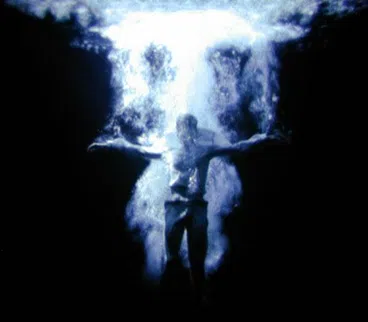
Bill Viola’s Ascension is in a section titled Saints And The Living Dead.
PHOTO: JAMES COHAN GALLERY
Japanese artist Mari Katayama, who had both her legs partially amputated, plays doll by layering cut-out legs in heels onto her own framed image.