
ArtScience Museum’s Flesh And Bones tackles human remains and historical drawings of the body
Sign up now: Get ST's newsletters delivered to your inbox

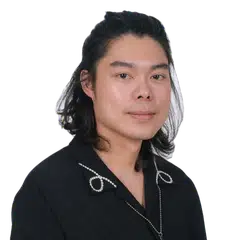
Curator Jerome Chee (left) and ArtScience Museum vice-president Honor Harger at the museum’s new major exhibition, Flesh And Bones: The Art Of Anatomy, on March 16.
ST PHOTO: JASEL POH

SINGAPORE – The human body – its sinews, its depictions and its enhancements – is the subject for dissection and wondrous study at a new ArtScience Museum exhibition that opens on March 21.
Curated as a circular experience, Flesh And Bones: The Art Of Anatomy begins and ends with Japanese artist Chiharu Shiota’s enveloping canopy of red yarn, a mesh of blood vessels equal parts soothing and threatening.
The Network Within tenderly draws from Shiota’s own battle with illness, but these are as well the red threads of fate – blood binding not just family, but also anyone who steps through this portal.
The landmark exhibition marshals a remarkable 160 artefacts and artworks, all ambitious in their framing and reframing of how the body has been documented and imagined over centuries.
Rare life-size prints of human musculature from the 18th century and preserved organ specimens come into lively dialogue with contemporary artists’ reckonings with scars and cyborgs.
The magic number is 30. More than 30 highly detailed historical prints and medical books – the ostensible stars of the presentation – have been loaned from art centre Getty Research Institute in Los Angeles, the United States.
Over 30 contemporary artworks have also been curated for the show to match, from Singaporean Woong Soak Teng’s photographs of people with scoliosis to a video of Stelarc with his algorithm-linked exoskeleton. The Australian performance artist famously attached an ear to his left forearm.
Human body specimens from Nanyang Technological University’s (NTU) Lee Kong Chian School of Medicine and Germany’s Institute for Plastination lend a more explicitly medical context. And so do the teaching aids from the Singapore College of Traditional Chinese Medicine that are generously given an entire room.
Crude distinctions between the sciences and the humanities go out the window, which is all in the right historical spirit. The ecorche figures in the Getty loans – representations of the body with the skin removed to reveal underlying structures – were used in the instruction of aspiring doctors, but also marketed to artists.

An ecorche figure by 18th-century printmaker Antonio Cattani.
ST PHOTO: GIN TAY
Curator Jerome Chee harks this tradition farther back to the Renaissance, and says during a preview: “In the academy of fine arts, there were sculptors, print-makers, painters. It was a huge institutional practice to study the body, at a time when anatomical dissections started to become more common.”
This has continued to the present. At NTU, doctors-to-be still learn from old texts and drawings, now adapted by an anatomical illustrator armed with an iPad.
Body to bodies
The wisdom of Flesh And Bones is that even the Getty loans depicting skinned bodies in their various degrees of torque, which held court in a 2022 production at the Getty Center, are not allowed to bask in their preserved glory.
The curatorial team has made special efforts to push beyond the “young, white male and fit” default of these historical studies to question the limits of this understanding in almost every room.
Woong’s series of photographs of people with scoliosis and fellow Singapore artist Yanyun Chen’s charcoal drawings of her own keloid scars are both feminine reclamations of real bodies in bone and flesh, making no apologies in staking equal territory.
Woong, whose spine was fused to a titanium rod with 16 screws when she was 13, shows her 2022 series of portraits capturing those with similar spinal curvatures. Her process is deliberately individualised – shooting mostly in volunteers’ bedrooms – and personal. She provides her subjects with iPads so they can see her view in real time and they can discuss poses to adopt.

Singapore artist Woong Soak Teng photographs individuals with scoliosis mostly in their bedrooms.
ST PHOTO: JASEL POH
Woong, 32, compares scoliosis correction to tree binding, a familiar sight in green city Singapore and which was an early medical allegory for scoliosis. “I wanted to retell the story of individuals with scoliosis in a way that is not objective and medicalised,” she says.
She has done the same with braces made of polyurethane foam that are moulded to each patient’s body, shooting them with an almost romantic touch and collecting them until studio mates forced her to throw them out.
There is real consequence to medical hegemony. The life-altering, expensive procedure still leaves Woong with some scepticism.
“Till today, I’m not sure if it was a fear-based diagnosis. My parents were told that if I didn’t go for surgery, my ribcage would start to twist. But I have a physiotherapist friend who looked at my X-ray and said I wouldn’t have had to go for surgery today. It’s also about time, how technology progresses and how information is communicated.”
In a penultimate room themed Anatomical Ideal, Hong Kong-based Chinese artist Liao Wen’s sculptures also question conceptions of the norm.
Her limewood figures, reclining and falling backwards off a height, shift attention to trust and care, and literally subvert classical ideals of uprightness and poise.

Hong Kong-based artist Liao Wen with one of her sculptures, inspired by an encounter with a disabled woman, during the installation for the exhibition.
ST PHOTO: JASEL POH
The 32-year-old’s inspiration was an encounter with a disabled woman in a chain restaurant in Hong Kong. “I didn’t know how to react, because both looking at her or avoiding eye contact would be rude. I realised I wasn’t educated to look at disabled people in China.”
Also responding to the theme, among others, are the abstract breast vessels of Thai artist Pinaree Sanpitak; drawings by Singapore pioneer life drawer Solamalay Namasivayam; Chinese artist Wendi Yan’s VH Award-winning speculative video on the exchange of medical knowledge between China and Europe; and a virtual-reality experience by London collective Marshmallow Laser Feast.

Chinese artist Wendi Yan’s Dream Of Walnut Palaces was the winner of the 2025 VH Award.
PHOTO: ARTSCIENCE MUSEUM
This last creation invites participants to go on a meditative journey through the body’s passageways as a cell. The de-familiarised cosmic surroundings now expand and contract with each cycle of participants’ breath.
Corpse teachers
This sprawling story has been given an additional emotional dimension in a dark sanctum near its heart.
Walled off, a room of preserved human organs and body parts is contextualised with the Lee Kong Chian School of Medicine’s recently introduced surgical dissection lessons, which draw inspiration from Taiwan’s Silent Mentor programme.
There is a touching photo of medical students taking an oath to “treat this once living human body with dignity” and to “show due respect and gratitude”, with one hand on their deceased “teachers”.

Students of Lee Kong Chian School of Medicine taking the anatomy pledge.
PHOTO: LEE KONG CHIAN SCHOOL OF MEDICINE
Students over time form personal connections with the bodies and the lives they led, including the sort of music and food that they liked. Some students have written poetry and songs and drawn comics in tribute to these donors – yet another rebuke to the science-art binary.
The Silent Mentor programme involves a philosophical recasting that is unique to this region of Singapore, Malaysia, Thailand, Taiwan and China. Curator Chee says: “It was forbidden to operate on bodies directly because of Confucian values in China. This shifts it by moving away from disrespecting the deceased to treating them as teachers.”
ArtScience Museum vice-president Honor Harger says the institution spent the most time on this section to fulfil its duty of care.
Before entry, visitors will have to read a guidance sheet. There will be crowd control and photography is forbidden. The museum will, however, not take on the mantle of monitor.
Ms Harger says: “It’s up to parents to decide whether or not they take their children inside. Parents may want to have a learning moment with their children and that’s up to them.”
There is a plastinated head, hand, heart, kidney and lungs – where organic matter like fat and water have been replaced with polymers to make them more durable – and organs like the gallbladder and cerebellum suspended in liquids.
Ms Harger is curious to see how visitors will react. “We’ve tried to create a reverential space because if you’re not an anatomy student or a medical student, it’s very unusual to come into contact with human remains.”
With these contemporary additions, the Getty loans are liable to lose some of its shine. But Getty Center curator Monique Kornell, who is in Singapore for the opening, says that even with the 2022 Los Angeles show’s narrower mandate, it was already one of the most popular exhibitions for the centre.
Especially in the post-pandemic context, “everybody can respond to the body or an image of the body”. And lest one forgets, the loans from the Getty Center are bona fide historical gems.
The three life-size ecorche figures by printmaker Antonio Cattani from 18th-century Bologna – “There’s only a handful in the world,” Ms Kornell says – were recently acquired by the Getty Research Institute, conserved and travelling out of the US for the first time since then.
Visitors can also get a close-up look of physician Andreas Vesalius’ 1543 De Humani Corporis Fabrica that challenged Galen’s ancient theory of the four humours and changed Western civilisation forever.
Ms Kornell’s pick for the most popular item of the 2022 show is toy manufacturer Renwal’s 1960 anatomical woman assembly kit, which lets collectors build a woman in the same way they can a model car. This comes with an optional feature allowing for a foetus and enlarged breasts to prepare the woman for pregnancy.
The after-effects of this medical Barbie have been surprisingly salubrious. Ms Kornell says: “People said, ‘I remember playing with that. This took me on my path to be a doctor.’”

French artist Orlan’s Entre Deux. Over decades, she has used plastic surgery to critique idealised beauty standards.
ST PHOTO: GIN TAY
She has no doubt the ArtScience Museum’s show will strike a similar popular chord here.
And why not? The Herculean men in the Cattani prints remain capable of holding up roof cornices and porticoes, while nearby, Hong Kong artist Angela Su’s monumental ink drawings of cyborg women effortlessly contain within them bulbs of nature and intricate machinery.
The de-centring gives visitors the best of many worlds; it is so many ways of reconnecting with the body.
Book It/Flesh And Bones: The Art Of Anatomy
Where: ArtScience Museum, 6 Bayfront Avenue
When: March 21 to Aug 16, 10am to 7pm (Sundays to Thursdays), 10am to 9pm (Fridays and Saturdays)
Admission: For Singapore residents: from $19.50 (adults) and from $16.50 (concessions); for non-residents: from $22 (adults) and from $18 (concessions)
Info: str.sg/k65q
Correction note: A previous version of the article said Nanyang Technological University’s Lee Kong Chian School of Medicine adopted Taiwan’s Silent Mentor programme. The university has since clarified it only drew inspiration from it.
