Indonesia rescuers search for survivors as quake death toll rises to 47
Sign up now: Get insights on Asia's fast-moving developments
- A 7.7-magnitude earthquake struck off Flores island, Indonesia, killing 20 people and injuring six, with rescue efforts ongoing amid landslides and aftershocks.
- Thousands fled as a tsunami warning was briefly issued and later lifted; authorities warned against returning to damaged buildings due to aftershock risks.
- Indonesia's location on the Pacific "Ring of Fire" causes frequent deadly earthquakes, with past quakes causing thousands of deaths and widespread damage.
AI generated
MAUMERE, Indonesia – Rescuers combed through debris for survivors on Aug 15 after a powerful earthquake struck off Flores in eastern Indonesia, killing at least 47 people, according to a disaster official.
A second strong quake was recorded thousands of kilometres away on Sumatra island in the west of the archipelago 12 hours later, but there were no initial reports of damage or casualties there.
Indonesia’s National Disaster Management Agency said on the evening of Aug 15 that at least 47 people had died in the quake, and rescue official Fathur Rahman said there were 50 people injured.
Suharyanto, head of the agency, said earlier that people were trapped in several buildings.
“These will be the initial targets of the disaster response teams,” said Suharyanto, who, like many Indonesians, goes by only one name.
Two helicopters and a plane were being readied to assist in rescue operations.
European Union chief Ursula von der Leyen offered help from the bloc’s Copernicus earth observation satellites.
“Europe stands ready to deploy Copernicus, our eyes in the sky, to support search and rescue efforts. Indonesia, we stand with you,” she wrote on social media platform X.
Dozens of houses and other buildings were damaged when the 7.7-magnitude quake hit the popular tourist island in Indonesia’s east.
Suharyanto said about 2,000 people had evacuated.
“I have never felt an earthquake this big,” Yulian Juita Ekalia, who lives in Ruteng city, more than 100km west of the epicentre, told AFP by telephone.
“It felt like we were on a trampoline. It was really scary,” said the 37-year-old university lecturer, who was jolted awake at around 5.30am local time.
“As I rushed to get outside, everything in the house fell down: the television, my son’s trophies, the dish racks, suitcases on top of the wardrobes. When I got outside, my son and neighbours were already there, screaming in fear.”
Rescue official Fathur Rahman told AFP the focus has shifted to locating victims who may be buried under rubble, but rescue efforts have been complicated by landslides cutting off roads.

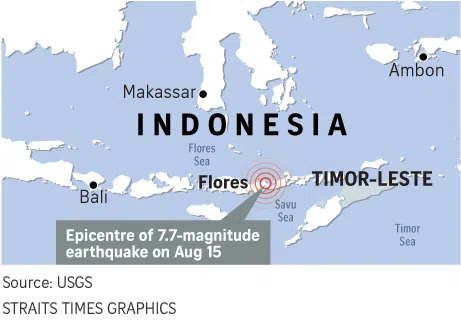
The epicentre of the quake was located off the north coast of the island, about 68km north-west of Ende, the USGS said.
PHOTO: USGS.GOV
Residents in Nagekeo, an area close to the epicentre, raced for higher ground as the sea retreated early on Aug 15 – a possible sign of an approaching tsunami, as witnessed by AFP journalists.
While a tsunami warning was lifted, the authorities urged people not to return to damaged buildings for fear that aftershocks may bring them down.
Hundreds remained outside by lunchtime as dozens of aftershocks continued shaking the island, the strongest of which was measured at 6.1 magnitude.
‘Panicking’
Yulian said she had dragged her stove outside and was cooking there, fearing further tremors.
She said she saw patients being treated under emergency tents outside a nearby hospital.

Villagers fleeing their homes after an earthquake in Talibura Village, Sikka, East Nusa Tenggara, on Aug 15.
PHOTO: AFP
Seeing images online of her university badly damaged, Yulian said she was “grateful that the quake happened on a Saturday morning when there was no campus activity... I can’t imagine what it would have been like if it happened while we were all there.”
Nagekeo resident Yohanes Babo, 56, said he was at a market when the earth started shaking in the early morning.
“The shaking was strong. Thankfully, we were already outside the house,” he told AFP.
“People were panicking, running here and there. We’re evacuating for the time being... and trying to get to the hills,” he said.
The epicentre of the shallow quake was located just off the north coast of the island, US and Indonesian authorities said.
The extent of the damage is still being assessed. The area is largely rural with few, if any, high-rise buildings.
‘Ring of Fire’
Long queues of people could be seen evacuating on foot, by motorbike and car, some piled into the back of pickup trucks, after the initial tsunami warning issued by Indonesia’s Meteorology, Climatology, and Geophysics Agency.
Indonesia experiences frequent earthquakes because of its location in the Pacific “Ring of Fire”, an arc of intense seismic activity stretching from Japan through South-east Asia and across the Pacific basin.
Flores was struck by a 7.7-magnitude earthquake in 1992, which triggered a tsunami and resulted in around 2,500 deaths.
A devastating 9.1-magnitude tremor in 2004 struck off the coast of Sumatra and triggered a tsunami that killed more than 220,000 throughout the region, about 170,000 of them in Indonesia, in one of the deadliest natural disasters in recorded history.
In 2018, a powerful quake shook the holiday island of Lombok, followed by several more tremors, killing more than 550 people.
Later that year, a 7.5-magnitude quake and a subsequent tsunami on Sulawesi island left more than 4,300 people dead or missing. AFP