
Xi and Lee reaffirm China-Korea ties at second summit in two months
Sign up now: Get insights on Asia's fast-moving developments
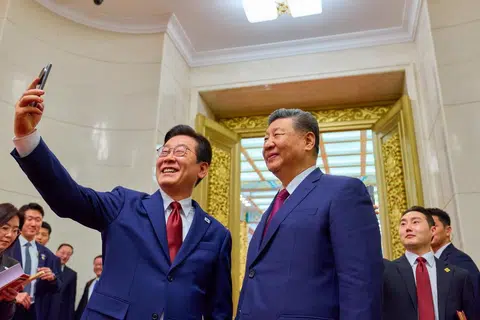
South Korean leader (left) Lee Jae Myung urged Chinese President Xi Jinping to help Seoul advance peace on the Korean Peninsula.
PHOTO: EPA
BEIJING – Chinese President Xi Jinping and South Korean leader Lee Jae Myung reaffirmed the value of their bilateral relationship at their second meeting in two months, signalling efforts by both sides to stabilise relations as geopolitical tensions mount.
At their summit in Beijing on Jan 5, Mr Xi said the frequency of their meetings showed the importance of the relationship, according to the official Xinhua News Agency. He added that Beijing and Seoul share common interests and should step up communication as neighbours.
Both countries should “respect each other’s chosen development paths, take care of each other’s core interests and major concerns”, and properly resolve differences through dialogue, Mr Xi told Mr Lee as he urged the South Korean leader to stand on the right side of history.
Mr Lee became the first sitting South Korean President to visit China since 2019, arriving in Beijing on Jan 4 for a four-day trip that will also include a stop in Shanghai.
The visit follows Mr Xi’s trip to South Korea in late October, his first in 11 years, when he emphasised the need for regional peace and stability and pledged deeper cooperation with Seoul.
“I hope to open a new era of South Korea-China relations together with you,” Mr Lee told Mr Xi. “This summit will serve as an important opportunity to make 2026 the inaugural year of the full restoration of South Korea-China relations.”
The talks took place against a backdrop of rising geopolitical tensions. Just days earlier, the US captured Venezuelan President Nicolas Maduro and brought him to New York for trial.
Closer to home, North Korea fired hypersonic missiles on Jan 4 as Mr Lee landed in China, a reminder of the security threat Seoul faces.
Mr Lee urged Beijing to help Seoul advance peace on the Korean Peninsula. “Peace is the fundamental foundation for prosperity and growth, and it is essential that our two countries work together to contribute to it,” Mr Lee said.
China remains Pyongyang’s most important backer, providing crucial economic support while the US and its allies maintain sanctions. In September, Mr Xi hosted Russian President Vladimir Putin and North Korean leader Kim Jong Un at a military parade in Beijing, where Mr Xi and Mr Kim pledged to deepen ties.
China-Japan Dispute
Mr Lee’s trip also comes as ties between China and Japan have deteriorated sharply after Prime Minister Sanae Takaichi suggested Tokyo could deploy its military if Beijing attacked Taiwan, a self-governing island China claims as its territory.
Beijing responded by urging its citizens to reduce travel to Japan and restricting imports of Japanese seafood.
Referencing China’s and South Korea’s fight against Japanese militarism more than 80 years ago, Mr Xi said Beijing and Seoul should “join hands to defend the fruits of victory in World War II and safeguard peace and stability in North-east Asia”.
Mr Lee reiterated his country’s respect for the “One China” policy on Taiwan, according to Xinhua, days after he made similar remarks in an interview posted by Chinese state broadcaster CCTV.
After the summit, Mr Lee posted photos on X showing himself with Mr Xi and the two countries’ first ladies. The photos were taken with a Xiaomi smartphone that the Chinese President had gifted him during his last visit to South Korea.
“The leaders agreed to restore strategic dialogue channels across a range of fields, including between foreign affairs and security authorities, in order to strengthen political trust between the two countries,” Mr Lee’s national security adviser Wi Sung-lac said at a briefing.
China has also agreed to cooperate in helping South Korean companies secure critical minerals, gradually expand cultural content exchanges and maintain close consultations on Chinese-built structures in the Yellow Sea, Mr Wi said.
Speaking at a business forum ahead of the summit, Mr Lee called for boosting cooperation in artificial intelligence, consumer goods and cultural industries to expand bilateral trade, which has remained at around the US$300 billion (S$384 billion) level.
“Exploring new routes and new markets is imperative,” Mr Lee said, citing beauty products, films, music, games as new areas that could offer breakthroughs.
Mr Lee was accompanied on the trip by top South Korean business leaders, including Samsung Electronics executive chairman Jay Y. Lee, SK Group’s Chey Tae-won and Hyundai Motor Group’s Euisun Chung.
The two countries signed 14 memorandums of understanding covering areas such as fine dust and food exports, and agreed to launch a ministerial-level commerce dialogue channel. South Korea’s Industry Ministry said the first meeting under the new framework will be held in the first half of 2026.
Since taking office in June 2025, Mr Lee has signalled an approach to foreign policy more balanced than that undertaken by his predecessor Yoon Suk Yeol, who favoured prioritising ties with Washington.
Still, South Korea’s status as a US ally limits how far it can move towards China.
Mr Lee’s four-day visit, scheduled to run through Jan 7, will include a meeting with Premier Li Qiang and a stop in Shanghai to visit a building that housed the Korean government-in-exile during Japan’s colonial rule of the peninsula before World War II. BLOOMBERG