For decades, the economic health of Orchard Road was measured by a visible metric: the number of flagship stores that global upmarket and high-street brands could pack along its 2.2km stretch.
Today, however, a different gauge of consumer appeal has emerged.
On a sweltering Saturday afternoon, long queues form at Orchard Central mall as teenagers wait their turn at Australian frozen yoghurt chain Yo-Chi, which opened its first overseas outlet there in 2025.
“Imagine one frozen yoghurt brand galvanising an entire section of Orchard Road,” said Sona Rai Aggarwal, managing director of retail sales and strategy for the Asia-Pacific at commercial real estate company Cushman & Wakefield.
“That is a good indicator that when you get the right brand, it is remarkably easy to activate the community.”
The scene captures the challenge facing Singapore’s prime shopping belt as it evolves from a traditional retail street into a destination that draws visitors and gives them reasons to linger, return and spend.
Seven years after the Orchard Road Rejuvenation Plan was unveiled, the mall-lined stretch is under pressure to go beyond its role as a shopping strip and become an experiential destination.
The Singapore Tourism Board (STB) continues to lead the effort.
A new Orchard Road Rejuvenation Initiative, unveiled in May, invites stakeholders to submit proposals on facade improvements, experiential concepts and night-time programming.
This comes on top of plans to infuse ready-to-use pop-up spaces into the shopping belt, as well as to redevelop heritage bungalows and a former school for hotel and mixed-use purposes.
But whether the rejuvenation will ultimately succeed remains uncertain.
Consumption patterns have shifted, while the convenience of suburban malls has eroded Orchard Road’s previous monopoly on retail convenience.
Data platform Statista Market Insights said the share of the Singapore population buying something via e-commerce rose from 33.8 per cent to 42.8 per cent between 2021 and 2022. It projects that e-commerce penetration will reach 71.6 per cent by 2030.
And with intensifying competition from shopping hubs in the region, such as Seoul and Bangkok, observers said Orchard Road must raise its game to stay relevant.

“The original logic of ‘come here because this is where the international brands are’ is no longer unique and clearly outdated,” said Natthavut Srinara, a lecturer and consultant at EHL Hospitality Business School.
Without a shift towards experiential novelty, he said, the famous strip risks becoming “a familiar mix in a nicer shell” to regional travellers who can buy the same products at home.
Aggarwal said younger consumers actively reject homogenised retail layouts.
“Consumers are looking for space to hang out – they want bespoke, unique, effortless journeys; stuff they can Instagram about,” she said.
Yet available data indicates that the street has not lost its pull.
While overall precinct visitorship is not tracked continually because Orchard Road functions as a public thoroughfare, STB’s 2025 Overseas Visitors Survey found that it remained among the top three non-ticketed sites that tourists visited in Singapore, drawing more than one in three international travellers. The other two most-visited sites are Chinatown and Merlion Park.
Orchard Road has also held on to its status as the world’s 13th most expensive retail destination, with annual rents climbing 2 per cent year on year to US$478 (S$620) per sq ft, based on Cushman & Wakefield’s Main Streets Across The World 2025 report.
The challenge is to turn casual passers-by into immersed patrons, or visitors who linger and return.
“For Singapore, it is doubly important to deliver a strong experience, given that we cannot compete on cost with regional competitors,” noted Wong Xian Yang, Cushman & Wakefield’s head of research for Singapore and South-east Asia.
What has changed – and what remains unfinished
Mooted in 2017 by the Urban Redevelopment Authority (URA) and STB, the Orchard Road Rejuvenation Plan was unveiled in 2019 to transform the shopping belt into a vibrant, lush and multifaceted lifestyle destination.
The blueprint, which guides development along the stretch over 15 years, has yielded an uneven scorecard.
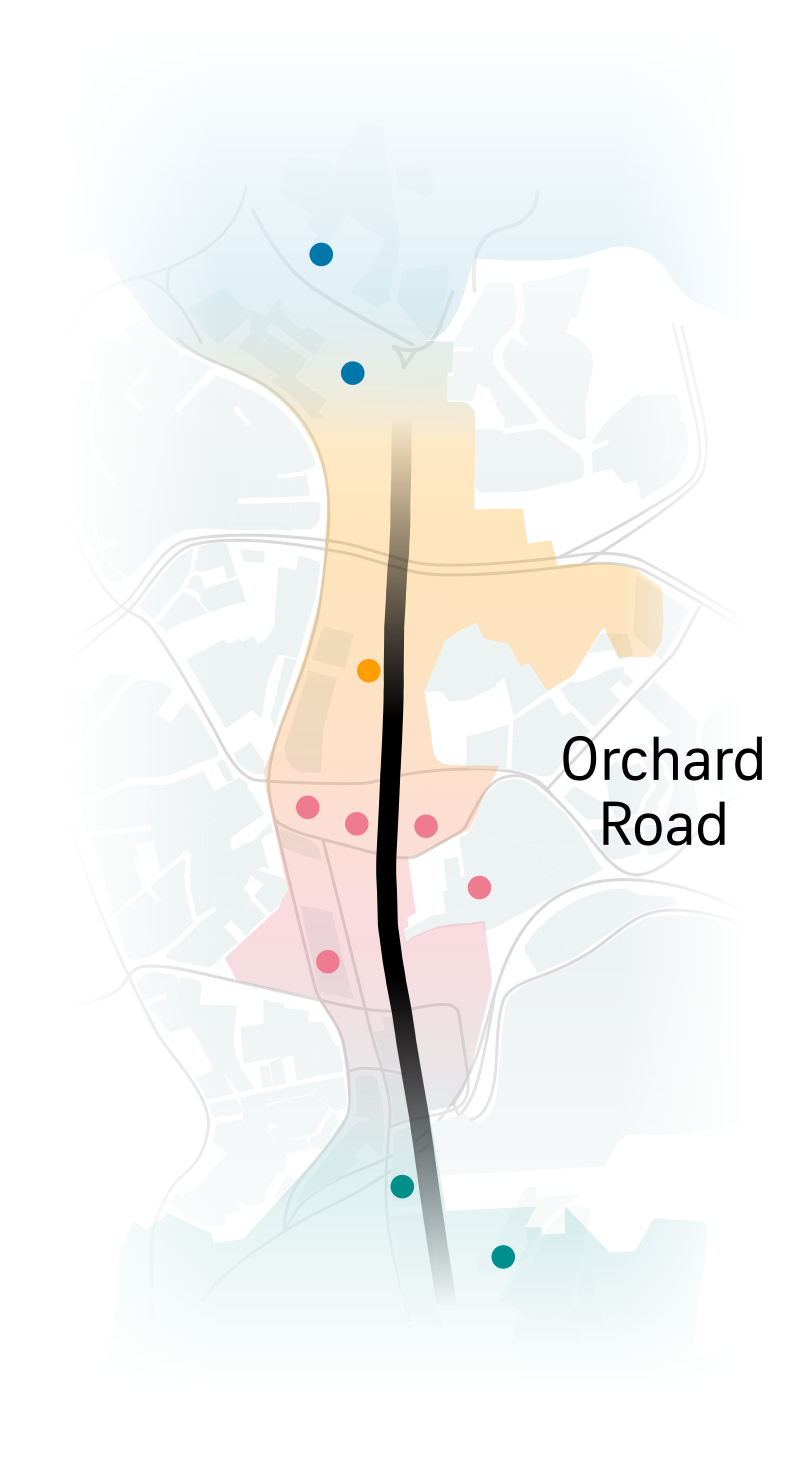
Orchard Road has four demarcated sub-precincts, each with its own identity.
The four neatly demarcated sub-precincts are starting to assume sharper identities: the Tanglin Road area has leaned into becoming a low-density arts and culture enclave; Orchard remains the retail heart; the Somerset Road area has solidified its identity as a youth-led lifestyle zone; and Dhoby Ghaut is becoming a family-friendly sprawling green oasis.
For instance, Somerset’s youth belt has a slew of anchor venues. Action sports facility Trifecta opened in 2023, *Scape reopened in November 2025 with new spaces where the young can study, create and play, and Live Nation is building a 3,000-capacity events venue in Grange Road.
Around 83 per cent of Trifecta’s visitors are Singapore residents who return regularly to train and improve their skills in snowboarding, skiing and surfing, while the remaining 17 per cent are international visitors.
The venue, which has conducted more than 110,000 surfing, snowboarding and skiing sessions since its opening in October 2023, has also opened Orchard Road’s only sheltered pickleball court and a wellness club with a hot bath and ice pools.
“These additions have brought new audiences into the precinct and contributed to making Trifecta a destination that people visit for a wider range of sports, wellness and community experiences,” said a spokesperson.
At the Dhoby Ghaut end, Temasek Shophouse reopened to the public in September 2025 with three times the space, and programming focused on social and environmental causes.
And after extensive restoration, Singapore’s last traditional Teochew mansion, House of Tan Yeok Nee, reopened in November 2025 with a heritage gallery alongside a tea house and bar.
Peak holiday programming, too, remains a draw. The 2025 edition of Christmas on A Great Street attracted a record 6.3 million visitors, up 7 per cent from the previous year, STB said.
Observers noted that the energy of Orchard Road, however, remains patchy between these seasonal peaks.

“On the big occasions, Orchard already behaves like one precinct... The problem is what the area feels like in between these peaks,” said EHL’s Natthavut.
“Day to day, Orchard is still experienced as a run of separate malls and hotels, each with its own logic. You get duplicated brands, uneven opening hours and very different levels of street activity from block to block.”
This is a sentiment mirrored by Lawrence Loh, professor of strategy and policy at NUS Business School, who said: “In the past, we looked at Orchard Road like a collection of assets... the precinct approach seems to have worked out well, but not all districts’ identities are there.”
At the Tanglin end, Tanglin Shopping Centre has been demolished and a mixed-use development will take its place. STB announced in May that heritage bungalows at Seton Close could be developed as a low-density hotel.
But it remains to be seen if its arts and culture identity will come out distinctively, said Loh, who added that this will depend on what kind of tenants and developers these spaces attract.
The curation problem
Orchard Road’s fragmented ownership and management structure make a top-down overhaul challenging, experts said. They pointed to Marina Bay Sands (MBS) as a counterpoint, where one entity controls the retail, dining, hospitality and entertainment mix.
To thrive, a precinct must be clear about its offerings and identity so that people know exactly what they are going there for, they added.
“Look at how well-executed MBS has been... conceiving the tenant mix of that mall and staying very, very true to their luxury segmentation. There are no mixed messages and no mixed signals,” noted Cushman & Wakefield’s Aggarwal.
Orchard Road Business Association chairman Mark Shaw said the precinct’s complex ownership structure is an inherent bottleneck.
“Rejuvenation in Orchard Road can be more complex because it involves a mature and highly built-up precinct with multiple stakeholders, different ownership structures and existing infrastructural constraints,” said Shaw.
Loh said the problem is rooted in the way that the shopping district was developed.
“It is hard to have a masterplan because of the way things are being created and nurtured,” said Loh, pointing to the fragmented way in which malls operate, with their own commercial interests.
“Orchard Road tries to be everything to everybody... but the more you plan, sometimes it backfires.”
For heartland consumers, too, the rise of mega suburban malls has made the city centre optional.

Yani Shahrin, a 19-year-old Institute of Technical Education student from Tampines, travels to Orchard Road only once every four or five months.
“We have Our Tampines Hub and three malls there,” said Yani. “You can get whatever you need there already.”
Her peer, student Rayyan Nizam, 18, said his friends actively bypass traditional mega malls such as Paragon and Wisma Atria because their budgets and tastes do not align with global high-street prices and brands.
“We prefer vintage things and thrifted stuff,” said Rayyan, who instinctively sticks to Bugis or looks online for subculture pop-ups when he wants to browse. “And if you do find it here (in Orchard Road), the price is quite high.”
He added: “I would return repeatedly to Somerset only if there were constant events (like flea markets), where my friends are running booths... Otherwise, it’s just a place we pass through.”
For mall operators and retailers, however, the draw of Orchard Road endures.
Tan Choon Siang, chief executive of CapitaLand Integrated Commercial Trust Management, said: “Orchard Road and suburban malls serve different customer needs and play distinct roles within our portfolio.”
The company owns Paragon, Plaza Singapura, The Atrium@Orchard and other malls in downtown Singapore, and holds a 50 per cent stake in Ion Orchard.
As Singapore’s premier lifestyle and tourism precinct, Orchard Road attracts local and international visitors, whereas suburban malls have a regular catchment of people spending on daily necessities, said Tan.
While both segments bring in healthy shopper traffic, tenant sales and occupancy levels, CapitaLand’s Orchard Road assets “remain highly relevant and competitive”, especially in their ability to draw flagship concepts, luxury brands and first-to-market offerings.
Tan also noted that shoppers are looking for “retail-tainment and lifestyle-driven concepts”, citing CapitaLand’s partnerships, which include a three-year agreement with Labubu maker Pop Mart on exclusive launches.
For a brand that originally grew out of an e-commerce marketplace, home-grown speciality coffee brand Morning saw value in establishing a physical presence in Orchard Road.
“Our first store at New Bahru was about building a community around speciality coffee,” said Leon Foo, the brand’s founder and chief executive.
“This second one at Takashimaya allows us to take that same philosophy and make it more accessible to people who may be discovering speciality coffee for the first time.”
Somerset’s success
Orchard’s larger rejuvenation plan appears to be concentrating its efforts, revolving around experiences and getting people to stay in the precinct for longer, on the Somerset belt.
Somerset’s shift from a shopping stretch to a youth-centric playground has been among the plan’s clearest successes so far.
*Scape drew 1.6 million visitors between its post-revamp reopening in November 2025 and June 2026, against a previously disclosed target of more than two million in a year.
Private ventures such as Trifecta draw regular board-sport hobbyists, but the biggest addition to this experiential belt will be Live Nation’s upcoming mid-sized entertainment venue in Grange Road.
Stephanie Bax, president for venue development at Live Nation Asia, said: “With a capacity of 3,000, this upcoming venue fills that missing piece in Singapore’s live entertainment landscape.”

The venue will be open to all promoters and organisers, making it easier to bring more international touring artists to Singapore while giving a platform to breakthrough acts who have outgrown club venues but are not yet playing in arenas, added Bax.
Construction is on track for completion by the end of 2026. Test events and specialised fit-out works are expected in early 2027, with operations starting before mid-2027.
The venue is expected to boost Orchard Road’s shift towards being a lifestyle destination.
Its programming will be coordinated with major STB precinct events, such as Grand Prix Season Singapore and Christmas on A Great Street.
Bax said the venue will also host talks, podcast recordings, markets, exhibitions and community events.
“By encouraging people to spend time here throughout the day, into the evening and across the week, we hope to encourage them to stay longer and return more often.”
Weather, rent and footfall
Whether Orchard Road’s plans succeed will depend on how they play out on the street.
At its Tourism Industry Conference in May, STB announced ready-to-use, “plug-and-play” pop-up structures between Wisma Atria and Ngee Ann City that will be available on short leases of one to six months.
The first ready-to-use spaces are slated to open by the end of 2026 and will operate until the end of 2028.
STB’s director of land and concept development Ashlynn Loo said these structures are intended to significantly lower the barriers to entry for brands looking to establish a presence in Orchard Road.
She added that the spaces would feature retail, food and beverage and lifestyle options that cannot easily be replicated online or in heartland malls. These could include new-to-market concepts, trendy brands testing new ideas or offering limited-time experiences, and up-and-coming local brands.
Some of this already exists at Night At Orchard, a recurring weekend bazaar, where 20 or more emerging brands set up stalls in the evening along the walkway fronting Ngee Ann City.
Yet, for vendors such as Puneeta Mhajan, 35, owner of local jewellery brand Shang Vito, weather, rent and guaranteed footfall are key considerations.
She currently runs a pushcart at Orchard Central, and her products are also stocked at shops in Katong and at Millenia Walk.
Mhajan said: “I am hesitating to do Night At Orchard because it is very expensive. It costs $975 for three days, whereas here (at Orchard Central), I am paying about that much for an entire week and I do not have to deal with the weather issues. Plus, I know I am guaranteed footfall in this mall.”

However, Cushman & Wakefield’s Wong said these street-level pop-ups are a step in the right direction.
“They allow emerging brands to test new concepts, fail fast and, where successful, transition into permanent stores,” he said.
For suburban consumers such as Zuhrah Bebi, 26, the pop-ups need to focus on exclusive brands from the region that cannot be found elsewhere in Singapore.
“Maybe freebies, or unique beauty brands that you cannot normally get, like Indonesian or Australian brands,” she noted. “Then maybe it is more enticing to come.”
Stiff regional competition
With tourism receipts hitting a record $32.8 billion in 2025, Singapore continues to pursue high-spending visitors as part of its “quality tourism” approach.
But Orchard Road is no longer just competing with heartland malls. It also faces an uphill race against regional heavyweights that have moved aggressively to create large-format experiential spaces.
In South Korea, 12-storey department store The Hyundai Seoul is an immersive space that has dedicated almost half its total area to indoor nature, including a massive indoor waterfall and a futuristic indoor forest.
It houses both luxury and subculture brands, such as local streetwear, and features a steady rotation of pop-ups that keep the facility fresh for consumers.
Closer to home, Bangkok’s Sukhumvit belt is dotted with gleaming, trendy malls such as the 200,000 sq m Emsphere and the sprawling One Bangkok mixed-use complex.
Every mall on the stretch has its own identity and clear positioning in terms of the shoppers it seeks to attract, and the brands overlap less, noted Aggarwal.
To regain its global cachet, Orchard Road needs recognisable lifestyle anchors that consumers can name and eventually seek out, said Natthavut.
“This could be a truly good food stretch, a standout cultural or lifestyle anchor; perhaps one large iconic emporium that feels different from the usual department-store format. So the conversation becomes ‘Did you check out X on Orchard?’ and not just ‘we went shopping’.”
Despite the headwinds, Orchard Road remains a prime regional showcase for international mega brands, with South-east Asia’s first Tiffany & Co Blue Box Cafe at Ion Orchard mall and the world’s first Louis Vuitton Apartment concept at Ngee Ann City.
But it has lost its default monopoly on novelty.
“Our flagships do not compare at all to the flagships in Seoul, Tokyo or Shanghai... We have lost that edge a little bit,” noted Aggarwal.
“We need to bring that edge back and attract first-to-market concepts.”
Looking for the ‘Yaohan moment’
As the new initiatives continue to materialise, Orchard Road faces a defining reality check.
While it has successfully created temporary reasons for people to visit, it has yet to prove these attractions can drive repeat visits and sustained, everyday business across the entire shopping belt.
That test will become more important as plans to pedestrianise and green parts of Orchard Road take shape.

Work began in 2025 to pedestrianise a 500m stretch in front of Plaza Singapura, the Istana and Concorde Hotel, linking it with an expanded Istana Park that will be three times its current size.
At the same time, Plaza Singapura and The Atrium@Orchard are set to undergo a $160 million revamp, with upgraded infrastructure that will integrate the indoor and outdoor areas along the stretch fronting the mall, in line with URA’s pedestrianisation efforts.
Relying on experiential concepts and lifestyle attractions to maintain or boost physical sales remains a commercial gamble, said observers.
E-commerce shifts are systemic and consumers may be perfectly content to enjoy experiences on the street without spending anything, noted Seshan Ramaswami, an associate professor of marketing education at Singapore Management University.
“Patrons may eat, enjoy experiences, meet friends and hang out – all without expenditure on shopping for physical goods.”
NUS’ Loh said “lifestyle” cannot be a manufactured marketing buzzword. Instead, the experience must feel authentic, localised and inherently unpredictable.
“Shops are not there to offer lifestyle for free; cash registers need to ring. How do you make that conversion?” he asked, pointing to local, ground-up success stories.
These include Liang Seah Street and Haji Lane, which blossomed organically because the “cultural soil” was right, rather than through rigid, top-down planning.
“We need a ‘Yaohan moment’ – a true sense of discovery,” said Loh, referring to the pioneering, iconic Japanese supermarket that shut here in 1997 after its parent company became insolvent.
STB’s Loo said: “What sets Orchard Road apart is that we are not competing on retail alone, but on distinctive experiences rooted in Singapore’s identity combining lifestyle, culture, events and a ‘city in nature’ environment.”
She also pointed to Orchard Road’s enduring appeal to global brands as “a testament to its continued X factor”, with the shopping belt attracting first-in-the-world and first-in-the-region concepts.
These include Prada’s first in-boutique Prada Caffe in South-east Asia at Ion Orchard and Korean beauty brand Jung Saem Mool’s first global flagship outside Seoul at 27 Scotts Road.
But the question remains whether Orchard Road can become a space where people actively return to immerse themselves in community and culture, rather than merely a thoroughfare they pass through to catch a movie or meet friends.

To secure its future, Orchard Road requires a concerted effort to become a lifestyle destination that responds to both street-level commercial realities and shifting consumer habits.
Such a pivot does not mean turning the entire belt into a theme park, but making it a place of discovery – where visitors see, taste or stumble upon something worth writing home about, said Natthavut.
This could take the form of consistent street-level programming, more open ground floors where cafes and hotel dining spaces spill outdoors, and a greater tolerance for pop-ups that are imperfect but interesting.
“The small things matter, too... Visitors remember hearing great live music, trying something they had not seen before, sitting outdoors, eating and people-watching,” said Natthavut.
“A good mix of bigger and smaller experiences would make Orchard feel alive, rather than just glitzy and air-conditioned.”
Aggarwal added: “Visitors are no longer looking for transactions alone any more. If we don’t actively try and change, constantly reinventing and pushing, Orchard Road will lose its lustre.”