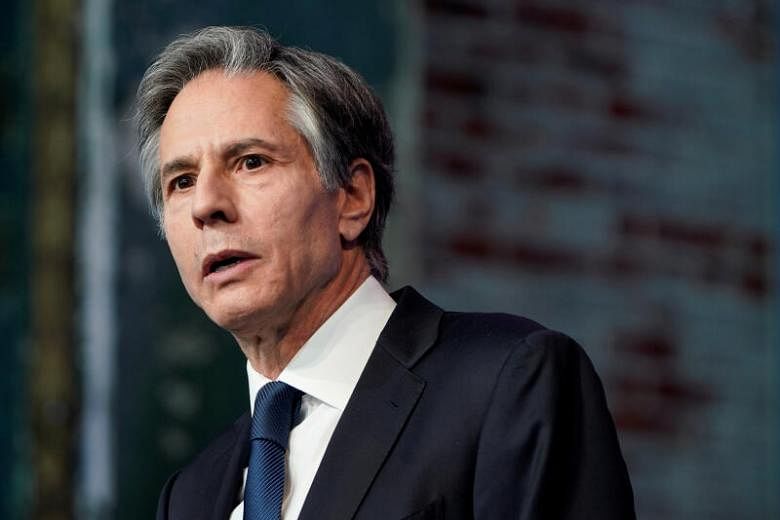
WASHINGTON (AFP) - Mr Antony Blinken, President-elect Joe Biden's choice to be secretary of state, will vow on Tuesday (Jan 19) that the United States will "outcompete" a rising China while reviving frayed alliances, in a sea change from President Donald Trump's go-it-alone "America First" approach.
On the eve of Mr Biden's inauguration, Mr Blinken was set to say at his confirmation hearing that the United States will seek to remain the pre-eminent global power but renew cooperation on common challenges such as Covid-19 and climate change.
"America at its best still has a greater ability than any country on earth to mobilise others for the greater good," Mr Blinken, a mild-mannered long-time aide to Mr Biden, was to tell the Senate Foreign Relations Committee, according to his prepared remarks.
"We can outcompete China - and remind the world that a government of the people, by the people, can deliver for its people," Mr Blinken said, paraphrasing former president Abraham Lincoln's paean to democracy two weeks after a mob of Trump supporters ransacked the Capitol in hopes of overturning Mr Biden's victory.
The stepson of a Holocaust survivor who found refuge in the US, Mr Blinken, 58, is known for his passion on humanitarian causes.
He is expected to win Senate confirmation although Republicans have vowed to press him hard on his consulting work since leaving the Obama administration four years ago.
In a sharp shift in tone from Mr Trump's secretary of state Mike Pompeo - who spoke of "swagger", "American exceptionalism" and global conflict with China - Mr Blinken said he would show "humility".
"Not one of the big challenges we face can be met by one country acting alone - even one as powerful as the US," he said.
"We can revitalise our core alliances - force multipliers of our influence around the world. Together, we are far better positioned to counter threats posed by Russia, Iran, and North Korea and to stand up for democracy and human rights."
Quick reversals from Trump
Mr Biden has promised to move swiftly after his inauguration at noon on Wednesday to reverse some of Mr Trump's most divisive policies.
He has pledged to rejoin the Paris climate accord, reverse the US exit from the World Health Organisation and end immigration agents' draconian separations of Latin American children from their families.
With the French-speaking Mr Blinken as his top diplomat, Mr Biden will want to repair rifts with Western allies that turned intensely personal under Mr Trump, who shattered protocol by publicly assailing his counterparts.
Mr Biden is expected to seek a return to the Iran nuclear accord negotiated under Mr Obama, believing that Mr Trump's exit and imposition of sanctions backfired badly, with Teheran escalating its contested programme.
Mr Biden also faces an immediate deadline with the Feb 5 expiration of the New START treaty on nuclear reduction, the last remaining arms pact with Russia.
Fellow Democrats have urged Mr Biden to temporarily extend the treaty, an option supported by Moscow, after the Trump administration unsuccessfully sought to expand New START by bringing in China.
In its final days, the Trump administration has taken a slew of major decisions seen as attempting to box in the next team.
Mr Jake Sullivan, Mr Biden's national security adviser, has criticised one such move - designating Yemen's Iranian-aligned Houthi rebels as terrorists, a step that aid groups warn will worsen a humanitarian crisis.
Mr Pompeo in his final days also redesignated Cuba as a state sponsor of terrorism, a move that will play to Mr Trump's Cuban-American supporters, but could require months to undo.
US permanently scarred?
With the world's eyes on the Capitol steps, new presidents have seized on inaugural addresses to make soaring statements of US international purpose, from Mr John F. Kennedy's Cold War warning of a "long twilight struggle" to Mr Obama's offer to adversaries "to extend a hand if you are willing to unclench your fist".
Mr Biden's inauguration will take place in a far darker atmosphere with virtually no crowd - due both to the pandemic that has claimed two million lives worldwide and ultra-tight security after the pro-Trump mob's Jan 6 attack on the very building where Mr Biden will take the oath.
"America's image is irreversibly harmed. The most Biden can do is hope to patch up a few potholes and hope it will be a bit less of a bumpy ride," said Mr Brett Bruen, a former US diplomat who heads the Global Situation Room consulting firm.
Dr Richard Haass, president of the Council on Foreign Relations, said that the political violence "should put an end to the notion of American exceptionalism".
"A post-American world, one no longer defined by US primacy, is coming sooner than generally expected - less because of the inevitable rise of others than because of what the United States has done to itself," Dr Haass wrote in Foreign Affairs.
