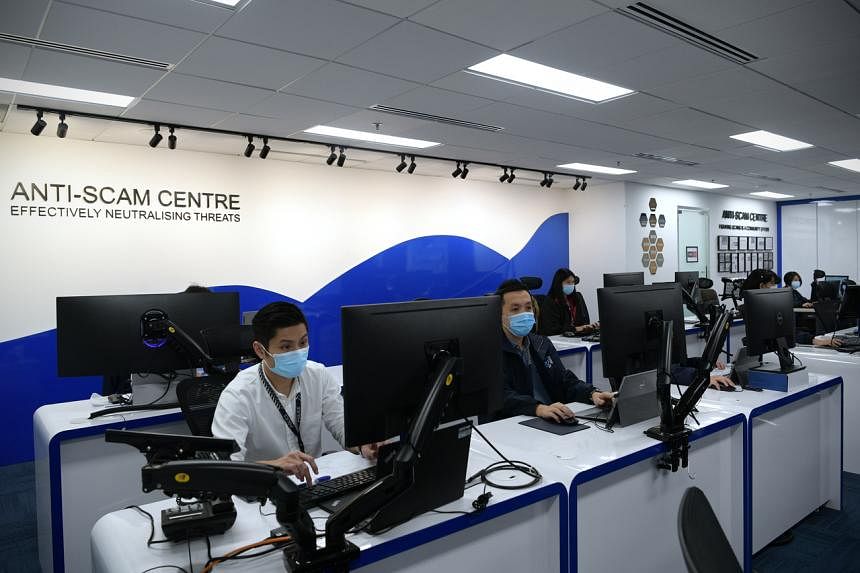
SINGAPORE - Before the Anti-Scam Centre was set up in Singapore, banks took an average of 14 to 60 days just to freeze a bank account, said Deputy Assistant Commissioner Aileen Yap at The Straits Times Stop Scams webinar on Wednesday (May 25).
"By the time, they (the banks) receive the letter from us, more often than not, the police would not be able to recover any money," she added.
Nowadays, working together with various financial institutions, the police are able to freeze bank accounts within a day, preventing the loss of victims' life savings.
This is achieved through Project Frontier (Funds Recovery Operations and Networks Team, Inspiring Effective Resolutions), which the police launched in 2020. It brings together banks, telcos, online marketplaces and other agencies to quickly identify scams and take down syndicates.
DAC Yap, who is the assistant director of the Singapore Police Force's Anti-Scam Command, said: "We need the (key) stakeholders to come together and fight scams with us. We need them to terminate telephone numbers, freeze bank accounts, do fund tracing as well as remove and block URLs fast."
"On our end, we will continue to step up our enforcement to fight scams. We will also continue to link up with overseas law enforcement agencies and we hope more can come on board," she added.
Dr Majeed Khader, chief psychologist at the Ministry of Home Affairs, also called for individuals to be equipped with digital literacy skills.
"We need to know about password designs, how scammers work, what is a phishing e-mail... it is a new set of skills that we need to prevent ourselves from being scammed. (This) is a new world that requires cyber digital intelligence," he said.
Mr Xavier Low, chief executive of Cyber Youth Academy, said that the organisation is running the Surf Safe campaign to help youth stay safe online, starting with secondary school students.
"We never know what is the next type of scam, but what we can do is to start from the youths, help them create a strong foundation to identify these scams and they can be their own detectors in the future," he said.
Cyber Youth Academy is a division of Cyber Youth Singapore, a non-profit organisation that aims to help Singaporeans adopt technology safely.
Mr Low added: "These youths can also be advocates. In my family, the youths are always the ones parents or the elderly approach for help when they are unsure about something related to technology. Let youths be the source of information when parents or the elderly are unsure. Let youths be empowered to help people in their communities to identify scams."