
Keys to the past: National Museum’s revamped Singapore History Gallery reopening on Oct 10
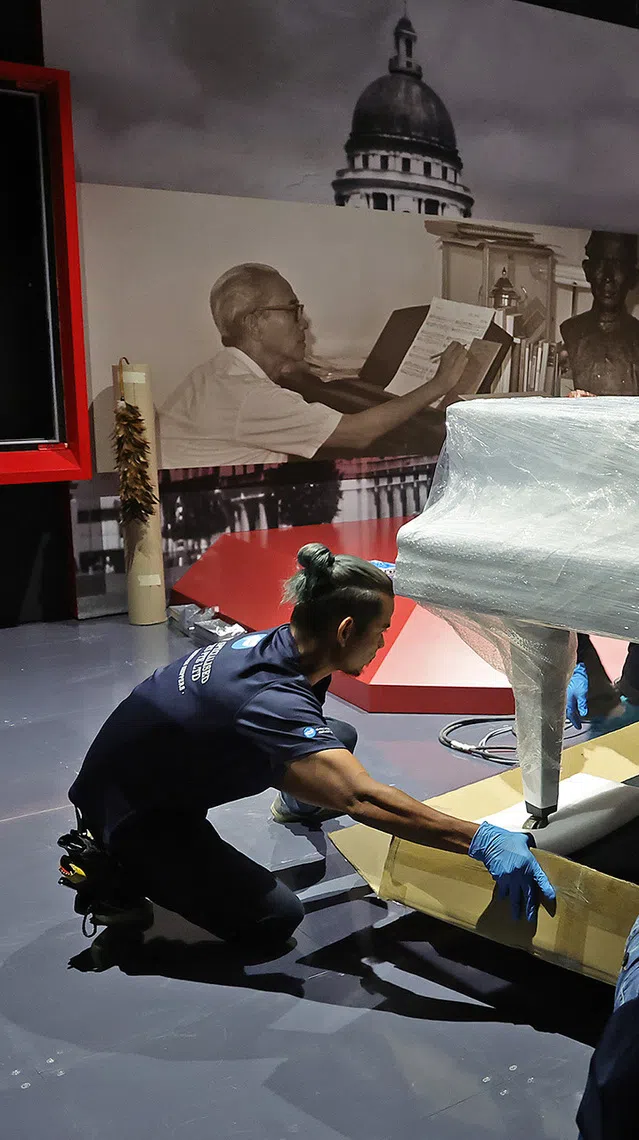
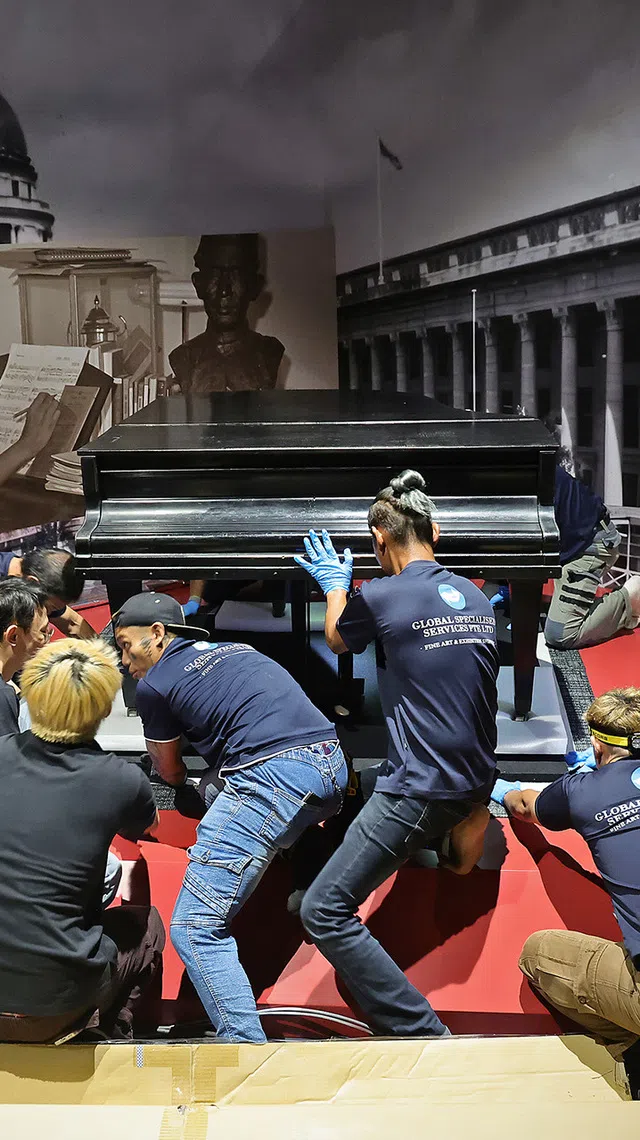
Ten men are carefully hoisting a century-old Strohmenger grand piano from a heavy cardboard encasement. “Move slowly!” a scribbled warning on the cardboard instructs anyone who would touch the antique.
When the instrument is finally placed onto an elevated platform, the palpable tension in the room melts into quiet relief.
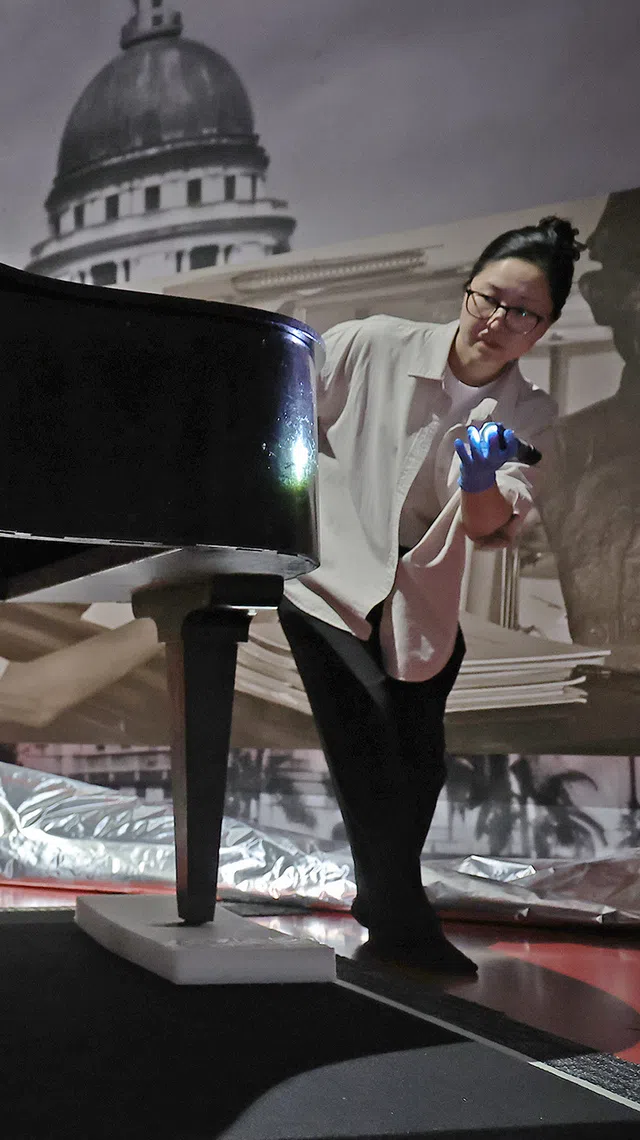
Lee Sang Hee, an assistant conservator at the Heritage Conservation Centre, immediately leans in with a torch to inspect the piano’s delicate frame.
The piano is more than just an old artefact. It belonged to the late composer Zubir Said, who used it to compose Singapore’s national anthem, Majulah Singapura.
When the National Museum of Singapore’s flagship Singapore History Gallery reopens on Oct 10 after an 11-month symphony of heavy lifting and delicate heritage preservation, the piano will take pride of place in it.

The words “Strohmenger & London” are inscribed on the iron framing of the piano in art nouveau style, referring to English piano maker John Strohmenger & Sons.

National Museum of Singapore assistant curator Kong Yen Lin (right) and Heritage Conservation Centre assistant conservator Lee Sang Hee checking Zubir Said’s piano after it was placed in position in the Towards a New Identity section.
For the first time, it will be a permanent exhibit. It was a temporary display at the museum in 2010.
And Zubir’s piano will share gallery space with a famous chair from the iconic Jiak Kim Street nightspot Zouk.

Art handlers gauging the space to display Zouk’s Septagon chair in the gallery’s Being Singaporean section.
“Museums, and the stories they tell, must evolve alongside the communities they serve,” said Chung May Khuen, director of the National Museum of Singapore.
“The revamped Singapore History Gallery is the culmination of that journey, shaped by new research, fresh perspectives and voices from our communities.”

Visitors will enter the Singapore History Gallery through Singapore Odyssea, an immersive multimedia prelude through Singapore’s key milestones and myths, as part of an integrated experience.
The gallery, which opened in 2006 and was previously refreshed in 2015, now has seven sections: Fluid Beginnings (1300s to 1800s), Colonial City (1800s to 1930s), Fall of the Fortress (late 1930s to 1940s), Towards a New Identity (1950s to 1960s), Becoming Singapore (1960s to 1980s), Being Singaporean (1980s to 1990s), and Looking Global (2000s to present).
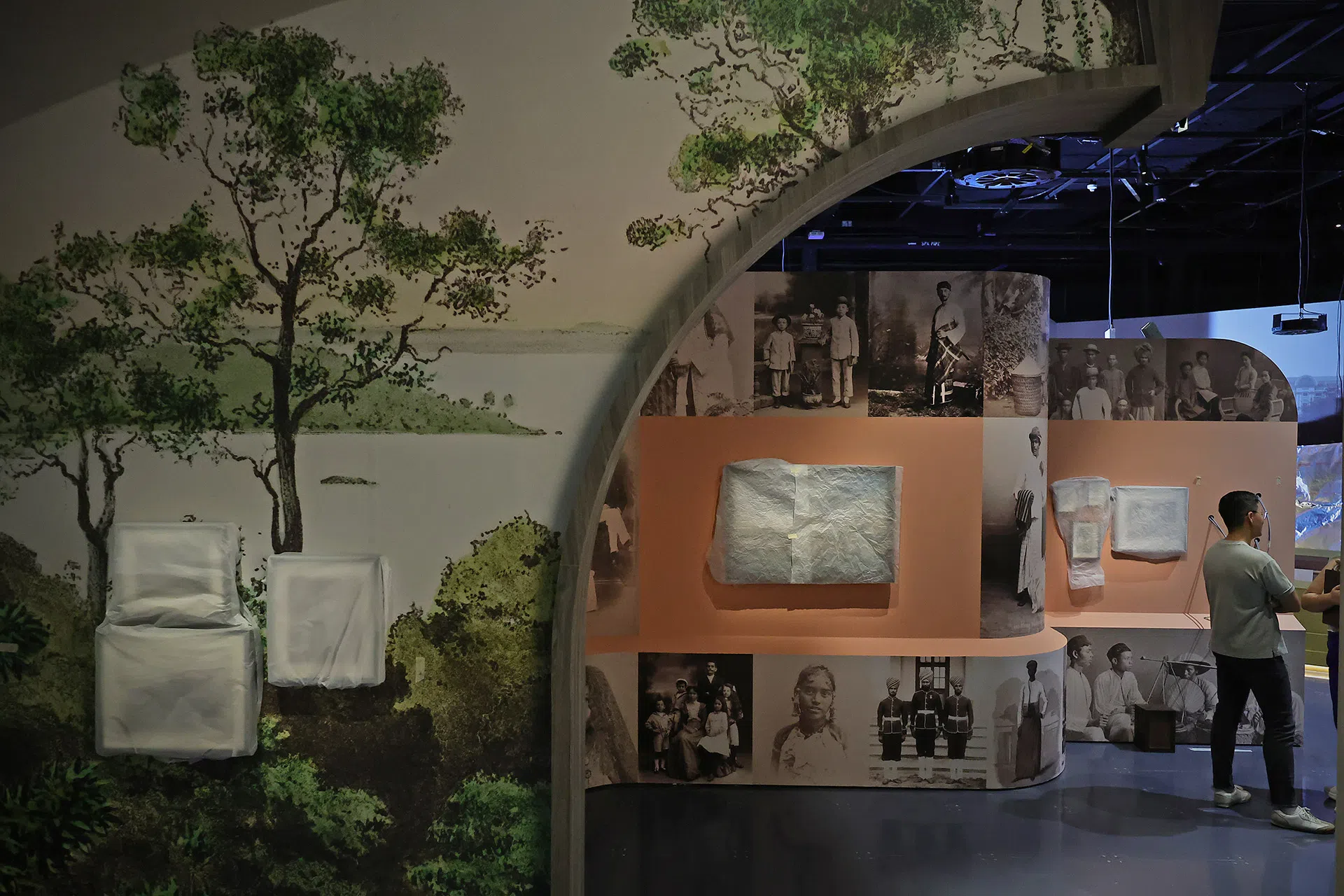
A showcase on migrants from China, India and the Malay Archipelago, who formed the labour backbone of the growing city, in the Colonial City section of the gallery.
Visitors will embark on an expanded chronological journey through more than 700 years of Singapore’s history, reflecting new academic research and public input gathered from over 160 focus group participants.

The National Museum’s exhibitions team checking the display and installation of a Japanese soldier’s khaki uniform and tank crew overall from the 1940s in the Fall of the Fortress section of the gallery.

An art handler aligning artefacts from the Indian National Army (INA) – a photograph of Captain John Jacob (left) and wartime paraphernalia (right) – using pencils and rulers for precise spacing in the Fall of the Fortress section of the gallery.
Displaying these age-old exhibits requires rigorous conservation decisions. For instance, Zubir’s piano, gifted to him in the 1950s by the Indonesian Club, will be showcased with its lid closed and keys encased in custom acrylic.
“Beyond the conservation consideration to protect the more delicate interior, we wanted visitors to encounter the piano as Zubir Said himself used it, as evidenced by archival photographs and markings on the instrument,” said Kong Yen Lin, assistant curator at the museum.
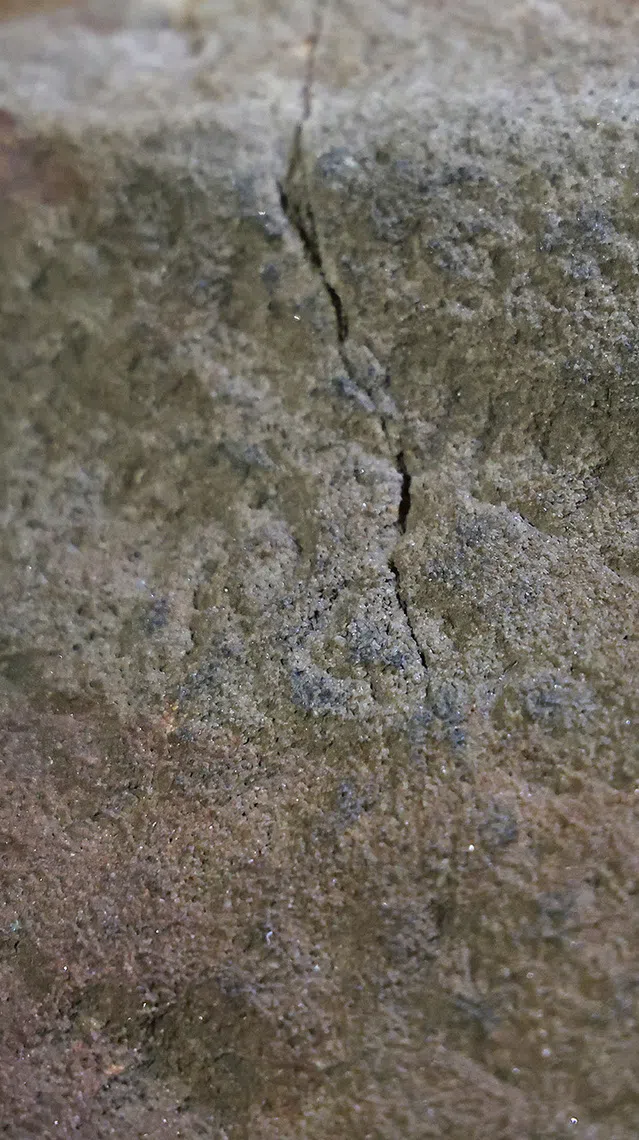
Every section had its own technical hurdles for art handlers and conservators.
In Fluid Beginnings, handling the 10th- to 14th-century Singapore Stone – the island’s oldest inscribed sandstone fragment – demands special care because of its heavy, fragile nature.

The Singapore Stone, the museum’s oldest inscribed artefact, is vital evidence of early Singapore’s regional connections.

Originating between the 10th and 14th centuries, it carries an undeciphered inscription in Kawi, the script used for documents in the Malay world.

Conservator Zhang Jingyi standing next to the Singapore Stone in the Fluid Beginnings section of the gallery.
In another corner of the Singapore History Gallery, a showcase titled Entering the Political Arena, in the Towards a New Identity section, is dedicated to late founding prime minister Lee Kuan Yew’s early legal career.

Art handlers positioning the barrister robe of Singapore’s founding prime minister Lee Kuan Yew in a showcase for the gallery’s Towards a New Identity section.
On display are artefacts such as his 1950s barrister robe and two Rolex Oyster Perpetual watches presented to him and his wife in 1953 by the postal workers’ union following successful wage arbitrations before he became prime minister.

The Rolex Oyster Perpetual watch that was presented to Lee Kuan Yew in 1953 can be viewed in the Towards a New Identity section.

The Rolex Oyster Perpetual watch gifted to Mrs Lee Kuan Yew is on loan from the National Trades Union Congress.
The relationships forged from his legal career were instrumental in helping him enter politics.

A People’s Action Party Chinese electoral leaflet about Lee Kuan Yew in the 1959 Legislative Assembly Election inside a showcase for the gallery’s Towards a New Identity section.

Lighting specialists walking through the Towards a New Identity section of the gallery. It features Singapore’s path to independence forged through civil unrest, political transitions from the 1950s elections to its 1965 separation from Malaysia, and the beginnings of a distinct national identity.
Singapore’s post-war and contemporary developments are in the spotlight at the gallery, too.
Newer artefacts include a traditional Nanyang coffee roasting machine from Ho Tit Coffee Powder Factory; a restored 1970s Housing Board lift that signifies the transition from kampung to HDB living; and nightlife institution Zouk’s original 1990s signboards and the custom seven-seater Septagon chair designed by interior designer Philips Connor.

A restored Housing Board lift from the 1970s (left) and a traditional Nanyang coffee roasting machine from Ho Tit Coffee Powder Factory.
PHOTOS: COURTESY OF NATIONAL MUSEUM OF SINGAPORE
“For many Singaporeans, Zouk was likely a formative experience,” noted assistant curator Samuel Lee.

Art handlers moving a box containing Zouk’s custom seven-seater Septagon chair to the Being Singaporean section of the Singapore History Gallery.

Nahid Matin Pour (left), a conservator based at the Heritage Conservation Centre, and National Museum of Singapore assistant manager Jolin See dusting the original 1991 Zouk signage from Jiak Kim Street before its installation.

The original 1991 Zouk signage from Jiak Kim Street being installed in its new permanent home in the Being Singaporean section of the gallery.

Art handlers mounting Zouk’s Phuture signboard from 1996 in the Being Singaporean section.
“The seven-seater Septagon chair was custom-designed to enhance the social experience, allowing multiple people to sit along its lobes and engage in conversation.”

Zouk’s Septagon chair, by interior designer Philips Connor, in the Being Singaporean section. The seven-seater chair was designed to allow multiple people to sit and engage in conversation.
The gallery’s overhaul coincides with the completion of a three-year restoration project for the National Museum of Singapore, which turns 139 in 2026.
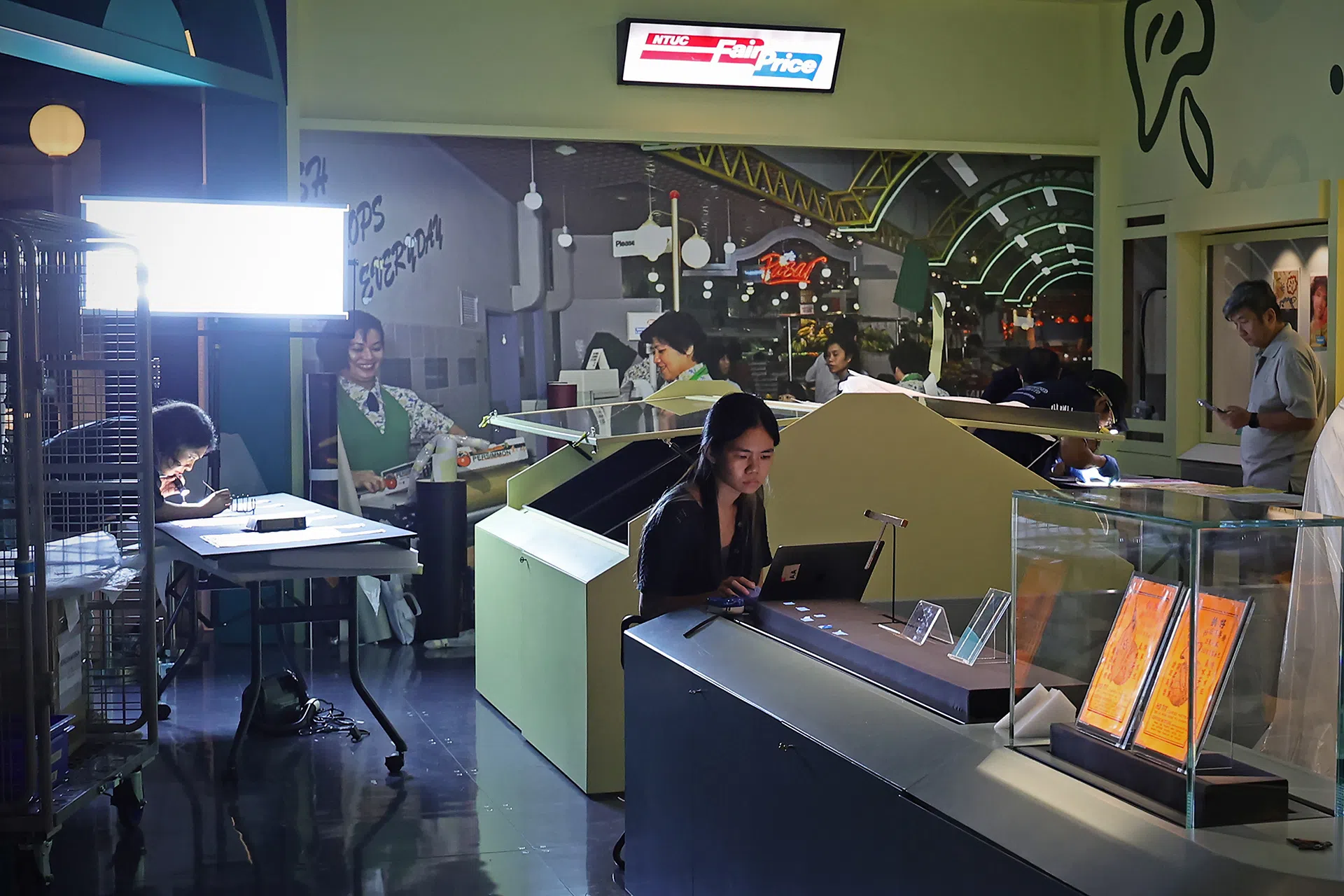
The National Museum’s exhibitions team and art handlers engrossed in their work, and blending in with the Eating Together showcase in the gallery’s Being Singaporean section.
The museum will mark its 139th anniversary and the reopening of the Singapore History Gallery with festivities titled Stories Of Everyday, running from Oct 10 to 18.
Celebrating the lived experiences of Singaporeans across generations, the week-long event will feature live performances, hands-on workshops, an art market and immersive installations.
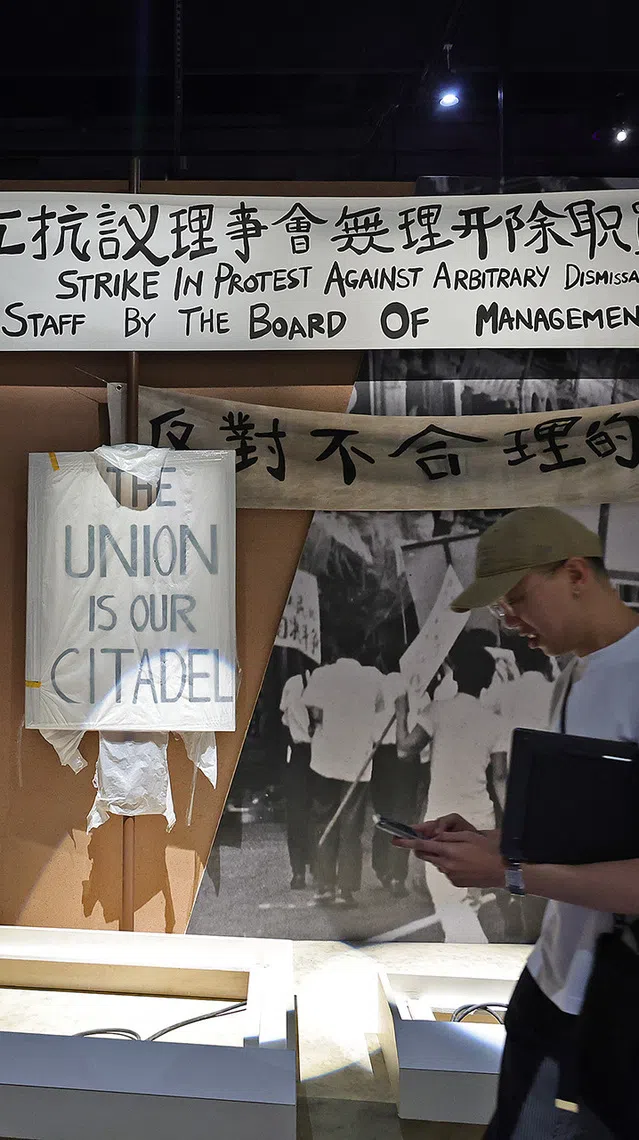
For the museum, the revamp of the gallery is about finding new ways to share Singapore’s stories and engage with its audience.
Alongside historical relics, experiential touchpoints – such as a “phygital” (blending physical and digital experiences) rickshaw display – bridge the gap between national milestones and personal memories.

A representative from creative technology studio CraveFX testing the “phygital” (blending physical and digital experiences) rickshaw installation in the Colonial City section of the gallery.

The interactive installation allows visitors to take on the role of a rickshaw puller and experience the daily grind faced by Singapore’s early street workers. The rickshaw’s weight was scaled down from 50kg to 30kg for visitor safety and accessibility.
“When the gallery reopens, we hope every visitor will find something that resonates with them and be inspired to reflect on what it means to be Singaporean today,” said Chung.
Produced by: Andy Chen, Irene Ang, Magdalene Phang, Kevin Lim and Neo Xiaobin
Main photographs and videos by: Kevin Lim