
It takes two: Parallel frames at the Asian Games
Visual coverage during major sporting events is a flurry of activity, with our photojournalists travelling to an average of two venues a day and covering a wide variety of sports.
This often means walking the last mile for 30 minutes, commuting by train across cities and waiting in the rain for long-haul buses with erratic timings.
While peak action, winning moments and “killer expressions” often form the main focus of sports coverage, our photojournalists sought to do something different at the 2026 Aichi-Nagoya Games in Japan.
NAGOYA – Across 16 days, as they covered multiple sports at the Asian Games in Japan, The Straits Times’ chief photojournalist Kevin Lim and executive photojournalist Mark Cheong came up with a collaborative visual project using diptychs.
It features pairs of images taken by each photographer, with shared details, visual compositions and moods.
Flying the flag, carrying the nation’s hopes

Shanti Pereira taking a moment to savour her victory in the women’s 200m final at Paloma Mizuho Stadium on Sept 27. ST PHOTO: MARK CHEONG

Tiffany Teo of Singapore being hoisted by her coach and husband Sim Kai Xiong after defeating Khilola Sobirova of Uzbekistan in the women’s traditional mixed martial arts 60kg final at Nagoya City Inae Sports Centre on Sept 22. ST PHOTO: KEVIN LIM
In two defining images of Singapore’s sporting triumph, the national flag became a poignant symbol of both solitary reflection and unbridled joy.
For sprinter Shanti Pereira, victory brought rare solitude amid the chaos – a fleeting moment spent with the red-and-white flag draped around her body, fully bowed as she absorbed the weight of years of silent sacrifice.
It was a stark yet harmonious contrast to mixed martial artist Tiffany Teo’s own euphoric celebration, where, similarly draped in the national colours, she was hoisted onto the shoulders of her husband and coach Sim Kai Xiong for an exuberant victory lap around the arena.
The weight of expectations

Badminton players Tan Ning and Liu Shengshu of China communicating with hand signals in their women’s doubles final loss to Baek Ha-na and Lee So-hee of South Korea at Ichinomiya City Municipal Gymnasium on Sept 29. ST PHOTO: KEVIN LIM

Singaporean wushu exponent Zeanne Law clinched Singapore’s first medal of the Games with a bronze in the women’s taijiquan and taijijian at Aichi Prefectural Martial Arts Hall on Sept 20. ST PHOTO: MARK CHEONG
No amount of hand signals and strategies could prevent the world No. 1 Chinese badminton pairing of Liu Shengshu and Tan Ning – Liu injured herself while trying to save a drop shot and Tan had to carry the load while her teammate hobbled in pain for the final set – from falling to the South Korean No. 2 pair of Baek Ha-na and Lee So-hee in the women’s doubles final.
Trained under a centralised state system from an early age, China’s athletes are conditioned to treat victory as national duty rather than personal triumph. In a sporting culture where only gold will suffice, silver and bronze medals serve as reminders of defeat.
The bronze medal won by Singapore’s wushu exponent Zeanne Law, however, was celebrated as the one that kick-started the nation’s medal chase at the Games.
Racing on different tracks

The legs of runners in the men’s 10,000m final are framed by cables on the photographers’ platform at Paloma Mizuho Stadium on Sept 25. ST PHOTO: MARK CHEONG

E-sports athletes, including Ar Muhammad Aleef (in white) of Singapore, racing to the finish line during the Gran Turismo 7 final at Aichi Sky Expo in Nagoya on Sept 23. ST PHOTO: KEVIN LIM
Whether it is the top-tier Diamond League in athletics or the popular video game League of Legends, victory is forged in milliseconds and refined through relentless repetition.
While traditional track athletes take years to perfect their stride, competitive gamers spend years developing the thumb calluses required to survive a best-of-three or -five series.
Having made its debut as a demonstration sport at the 2018 Asian Games, e-sports became a medal event in Hangzhou in 2023 and remained on the programme at the Aichi-Nagoya edition.
Athleticism at its peak

Thailand’s Jutatip Kuntatong executing a kick during the women’s teqball doubles semi-finals at Nagoya City Higashi Sports Centre on Sept 19. ST PHOTO: MARK CHEONG

Yun Kyu-sung of South Korea executing his routine as he emerged victorious in the men’s individual poomsae event at Toyohashi Gymnasium in Aichi on Oct 1. ST PHOTO: KEVIN LIM
Suspended in midair above the curved table, the teqball player contorts her body horizontally, delivering an explosive smash that barely clears the net before snapping onto her opponent’s side.
It is a feat of aerial mastery that would look right at home in a martial arts arena.
The biomechanics of teqball’s signature acrobatic kicks bear a striking resemblance to those of a taekwondo exponent executing an airborne technique in poomsae.
After launching their bodies off the ground, both athletes must generate immense rotational force through sheer core strength, contorting their physical forms with precision and power at the apex of their jumps.
In that fleeting second of seemingly complete weightlessness, competitive sport transforms into pure acrobatic geometry.
Lights and lines
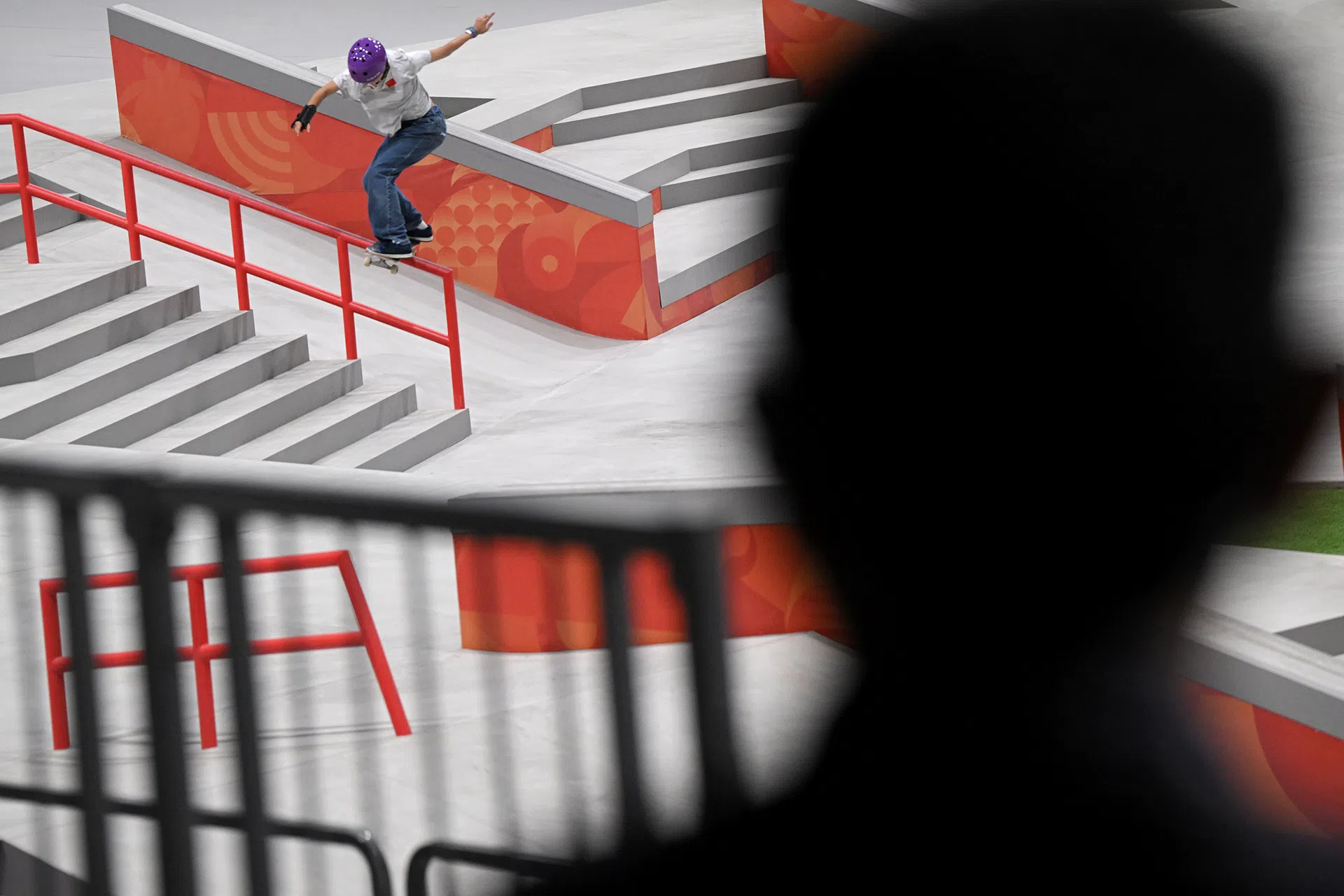
A skater is framed by the silhouette of a spectator during the women’s street skateboarding final held at Aichi Sky Expo on Sept 27. ST PHOTO: MARK CHEONG
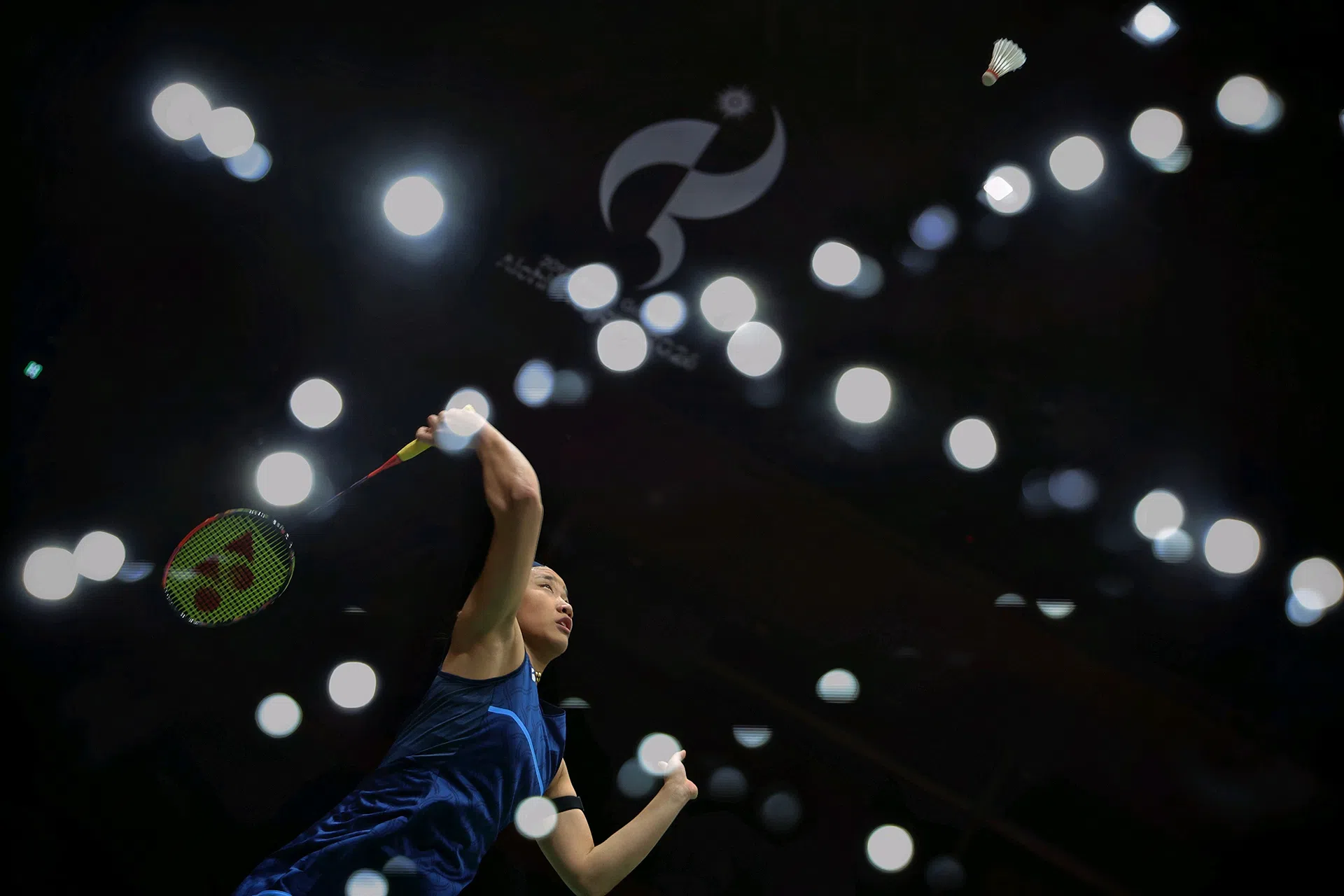
An Se-young of South Korea returning a shot to Akane Yamaguchi of Japan during the women’s badminton singles final at Ichinomiya City Municipal Gymnasium on Sept 29. ST PHOTO: KEVIN LIM
The beauty of sport encompasses not only an athlete’s actions and emotions, but also how they blend in with or stand out from their surroundings.
At the women’s street skateboarding final, it looked less like a competition and more like a demonstration in an urban street plaza, which the course was designed to mimic.
The geometric shapes of the obstacles, including the rails, ledges and embankments, were a pleasant change from those found at other sporting venues.
Over at badminton, photojournalist Kevin Lim used an in-camera double exposure technique to frame South Korean world No. 1 An Se-young as she leapt, juxtaposed against the indoor lights, for a smash during her women’s singles final against Japan’s Akane Yamaguchi.
Small ball, big ball, same goal

Shin Yu-bin of South Korea serving during the women’s table tennis singles quarter-finals at Sky Hall Toyota on Sept 26. ST PHOTO: MARK CHEONG

Kuwait players (in dark blue) defending a corner during a men’s football group match against Uzbekistan at Nagoya City Minato field on Sept 18. ST PHOTO: KEVIN LIM
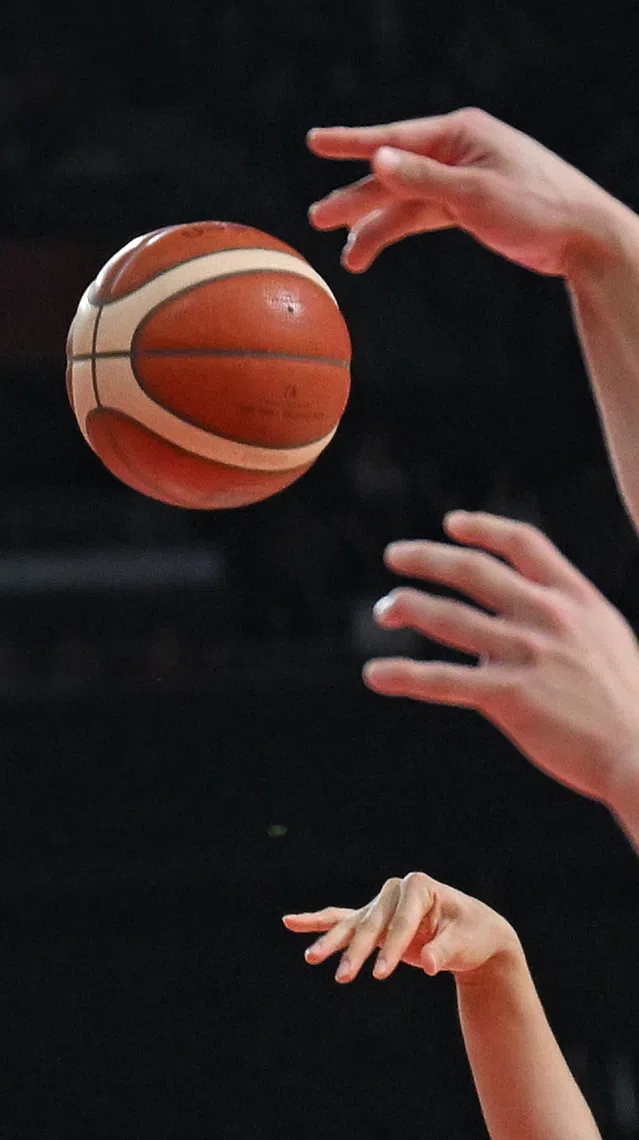
At first glance, football and table tennis have little in common. One uses a ball that is more than five times the size of the other.
Football is played on a 105m by 68m pitch, while a table tennis table measures about 2.7m by 1.5m.
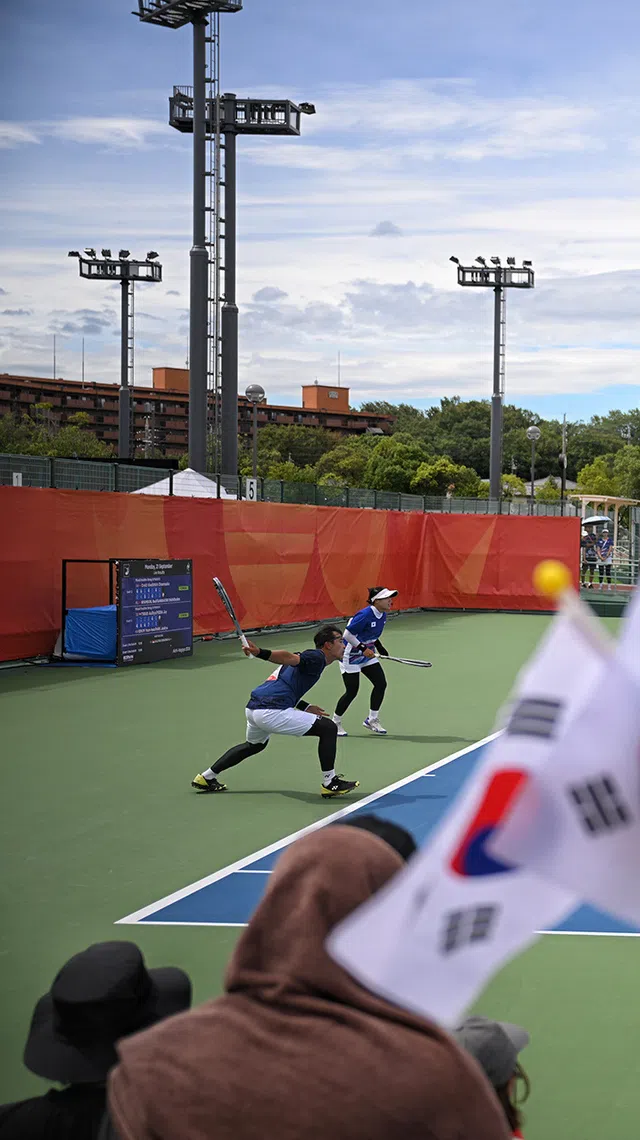
But both sports rely heavily on exploiting angles and position, whether through a well-rehearsed corner kick routine to bamboozle opponents or a heavy sidespin serve to open up the far corner.
Victory in both sports is more often than not achieved by those who dictate the tempo and make the best use of space.
Same same, but different

Sogand Sinkaeichetan of Iran is kicked in the face by Aparna Dahiya of India during the women’s 52kg sanda quarter-finals at Aichi Prefectural Martial Arts Hall on Sept 20. ST PHOTO: MARK CHEONG

Bao Ziyi of China (in red) punching Luu Diem Quynh of Vietnam in the face during the women’s 75kg boxing semi-finals at Nishio Gymnasium on Sept 30. ST PHOTO: KEVIN LIM
In the two photos, it is easy to mistake one sport for the other. Sanda, also known as Chinese kickboxing, can look visually similar to Western boxing.
Donning protective gear such as padded gloves, athletes in both disciplines commonly score with clean strikes to the head. The sanda exponent and boxer also share an arsenal of jabs, crosses, hooks and uppercuts.
When covering sanda and boxing, the differences become apparent.
While boxing is strictly limited to upper-body striking using closed fists, sanda is a full-contact sport that combines punches, kicks, knees, takedowns and throws.
Covering the games
From the get-go, an eight-to-eight work day easily stretched to eight-to-late during the Games.
Unlike other major sporting meets, shuttle buses were few and far between in Japan, which meant the majority of commutes to venues were via public trains and buses.

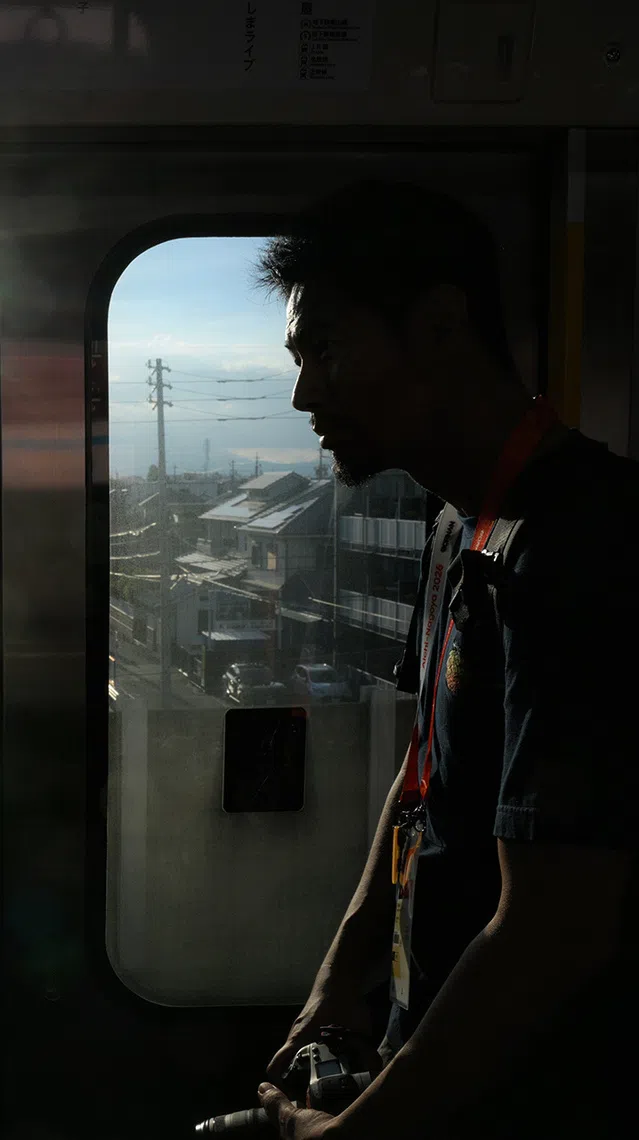
Chief photojournalist Kevin Lim typing the text for this particular interactive story on his 90-minute commute to the boxing venue in Nishio on Sept 30. ST PHOTO: DEEPANRAJ GANESAN

Executive photojournalist Mark Cheong (centre) walking to the gymnastics venue with Lianhe Zaobao sports correspondent Chantele Ho (left) and The Straits Times sports correspondent Kimberly Kwek at Nagoya General Gymnasium on Sept 25. His average step count over the Games was 14,000 per day. PHOTO: COURTESY OF JEREMY KWAN
This became a daily sports event by itself – the photographers usually had to walk from train stations to venues that were often 15 to 30 minutes away by foot.
The silver lining of this inconvenience was that it allowed the photographers to take in another side of Aichi and Nagoya, passing little residential neighbourhoods, busy intersections and getting a feel for daily life in Japan.
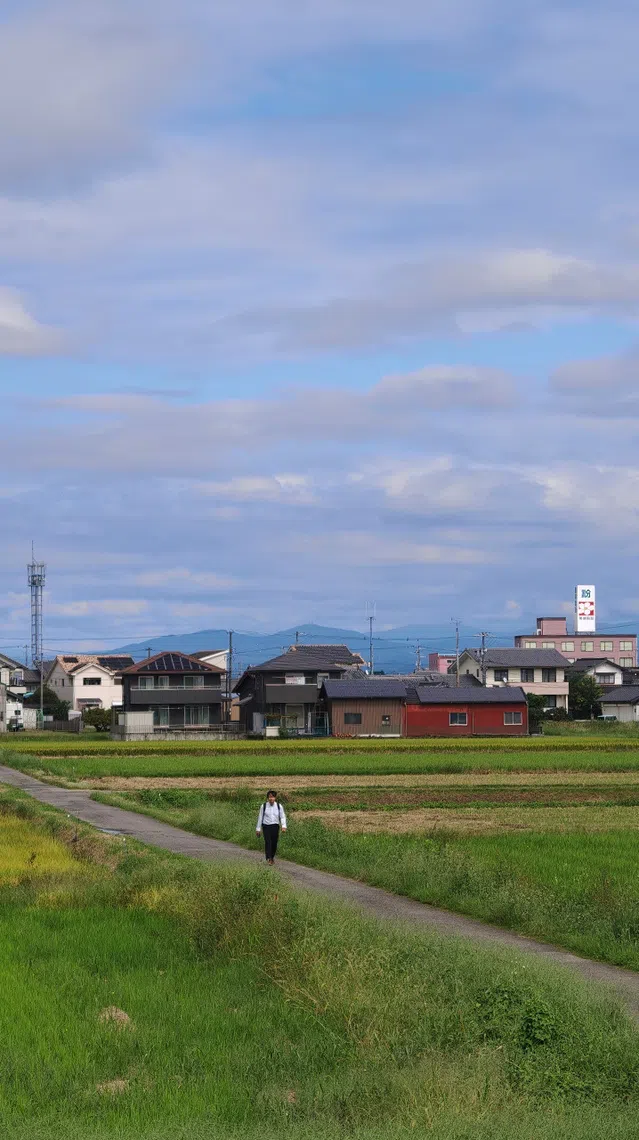
After a 90-minute – or even up to a 180-minute – commute out of Nagoya city into the outskirts of Aichi prefecture, scenes such as this in Nishio soothed the eyes and mind of a hurried photojournalist.
ST PHOTO: KEVIN LIM
Thousands of photographers and reporters descended upon Japan for the Asian Games, all trying to get an exclusive story or that one-of-a-kind picture that would set them apart from other media outlets.
Positions for photographers almost always involved getting to the venue early to queue up to “chope” prime spots, which were often very limited.
Certain venues also had protocols that prevented the media from taking up prime positions, meaning some sneaking around was needed to get the best shot.

Chief photojournalist Kevin Lim (background, second from right) covering Singaporean shuttler Loh Kean Yew’s badminton single’s final against Kunlavut Vitidsarn of Thailand at Ichinomiya City Municipal Gymnasium on Sept 29.
ST PHOTO: MARK CHEONG
One of the main highlights of the Games was covering the 100m and 200m athletics finals, where Shanti Pereira won silver and gold respectively.
If Pereira was to recreate her feats from the Asian Games in Hangzhou in 2023, the team wanted to have as many angles as they could to make sure that they captured not only the action of the races but also her emotions after she crossed the finishing line.
Mark Cheong would take a higher, “safer”, angle to get a head-on shot of her alongside the other competitors, while Kevin Lim would position himself on the ground level to get close-ups and reactions of Pereira post-race.
Cheong also set up a remote camera at the finishing line to get as close an angle of her as possible at the end of her races.

Mark Cheong setting up a remote camera near the finishing line to capture both Shanti Pereira and Thai sprinter Puripol Boonson’s runs during the women’s and men’s 200m finals respectively at Paloma Mizuho Stadium on Sept 27. PHOTO: COURTESY OF JEREMY KWAN
The rain also came down hard from the second day of athletics, making it increasingly challenging for the photographers to keep their gear dry while chasing moments.
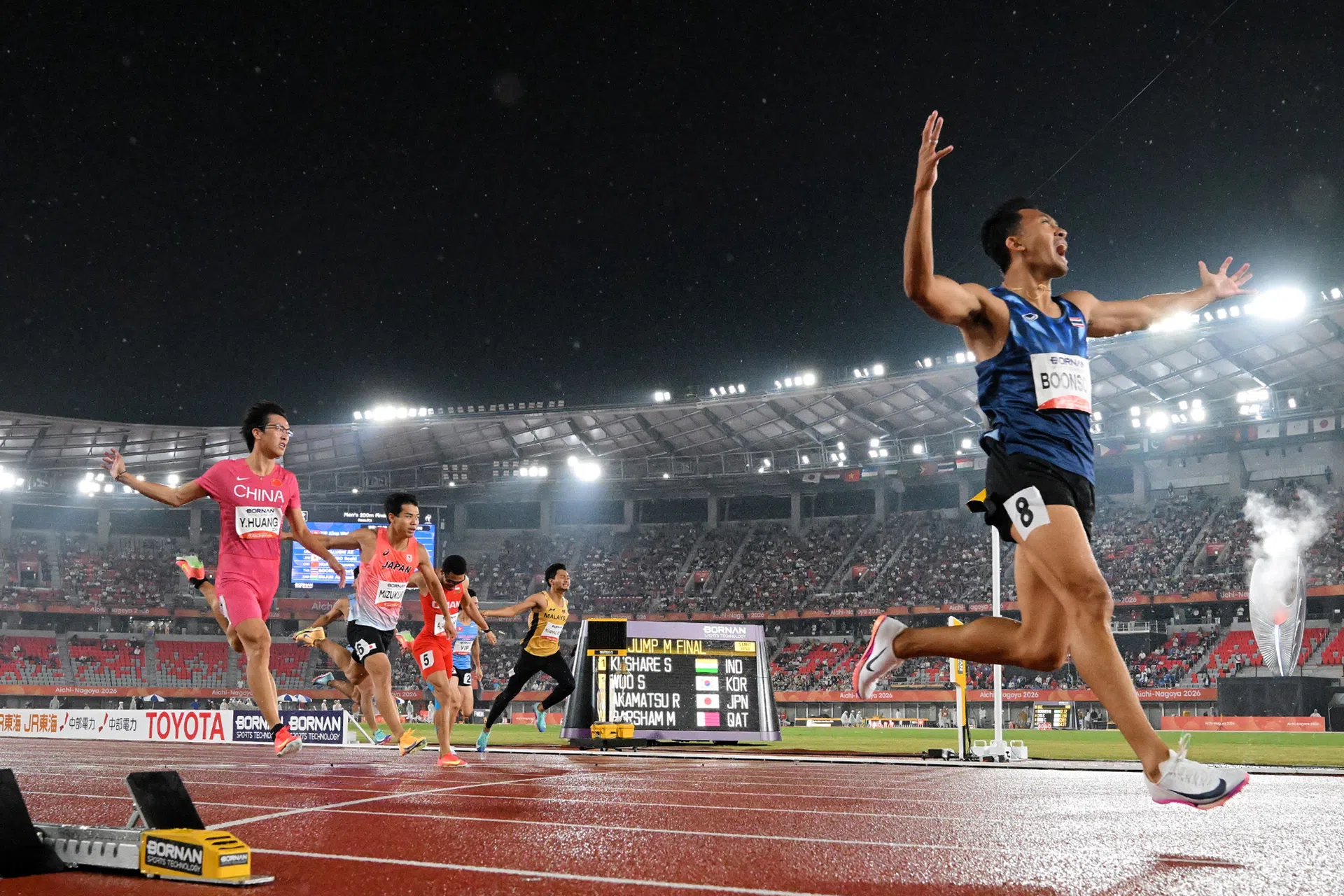
Puripol Boonson (right) of Thailand was captured using a remote camera as he crossed the finish line at the men’s 200m final at Paloma Mizuho Stadium on Sept 27. Executive photojournalist Mark Cheong travelled to Aichi Sky Expo, where he covered the women’s street skateboarding final in the morning before walking over to an adjacent hall in the same place to shoot the men’s epee team and women’s sabre team fencing events, before commuting for an hour and a half to Paloma Mizuho Stadium to cover the athletics finals. ST PHOTO: MARK CHEONG

Singapore’s Shanti Pereira in jubilation after finishing first in the women’s 200m final on Sept 27. Chief photojournalist Kevin Lim shot the men’s badminton quarter-finals at Ichinomiya City Municipal Gymnasium in Aichi Prefecture earlier in the day before heading to Paloma Mizuho Stadium to cover athletics after a two-hour commute. ST PHOTO: KEVIN LIM
How could this interactive story not include other personal favourite frames, including those that made neither the print nor online stories? They deserve to see the light of day.
FAVOURITE OUT-TAKES

Patricia Geraldine of Indonesia competing in the women’s jianshu and qiangshu final held at Aichi Prefectural Martial Arts Hall on Sept 23. ST PHOTO: MARK CHEONG

Samuel Robson (right) of Singapore duelling with Ryan Choi of Hong Kong during the men's foil Individual quarter-finals at Aichi Sky Expo Hall on Sept 22. ST PHOTO: MARK CHEONG

Rin Suzuki of Japan taking part in the men’s javelin final held at Paloma Mizuho Stadium on Sept 28. ST PHOTO: MARK CHEONG

Sailors racing during the women’s ILCA 6 final at Kaiyoh Yacht Harbour at Mikawa Bay in Gamagori City on Oct 2. ST PHOTO: MARK CHEONG

Park Jae-woon of South Korea grimacing as he tries to break out of a hold by Mahmoud Jabr of Jordan during the men’s jiu-jitsu 77kg semi-final at Aichi Prefectural Martial Arts Hall on Oct 2. ST PHOTO: KEVIN LIM

Accompanied by her coach and husband Sim Kai Xiong, Tiffany Teo of Singapore was a picture of concentration as she stepped into the arena for her bout against Suchika Tariyal of India in the women’s traditional mixed martial arts 60kg semi-final at Nagoya City Inae Sports Centre on Sept 21. ST PHOTO: KEVIN LIM

Thai gymnasts performing a ball routine during the rhythmic gymnastics group all-around qualification at Nagoya General Gymnasium on Oct 2. ST PHOTO: KEVIN LIM

Tom Kim of South Korea celebrating against the backdrop of Mount Miroku after winning the men’s golf individual gold medal at Kasugai Country Club East Course on Oct 3. ST PHOTO: KEVIN LIM
Produced by: Mark Cheong, Kevin Lim, Neo Xiaobin and Suneeta Devi
Photographs by: Mark Cheong and Kevin Lim