
Asian Insider
No ghosts, just good food: Pontianak shines on the Equator
PONTIANAK – For many Singaporeans and Malaysians, the word pontianak might conjure up eerie images of a vengeful female spirit that is said to appear under the full moon – thanks in no small part to Malay horror films and urban myths.
But when I arrived in the city of Pontianak in West Kalimantan, I found little trace of this ghostly apparition, despite my best efforts.
Legend has it that up till the 18th century, the site where Pontianak now stands was a ghost-infested wilderness, unfit for human habitation. Then, in 1771, Syarif Abdurrahman Alkadrie, a prince of Arab and Malay descent, arrived from nearby Mempawah and drove out all the pontianak (or kuntilanak as they are known in Indonesian) by firing cannons, thus establishing the Sultanate of Pontianak.
The sultan’s expedition appears to have been a resounding success, because current-day Pontianak residents do not seem to have any fears that the spirits might show up when it gets dark. There are no ghostly walking tours or designated haunted sites, and a proposal to erect a kuntilanak statue in the city centre was abandoned due to lack of interest.
“Oh yes, Pontianak does mean kuntilanak in Malay,” Pontianak native Muhajir, 36, told me when I asked. “But I haven’t really heard of any sightings around here. Maybe further out in the jungle.”
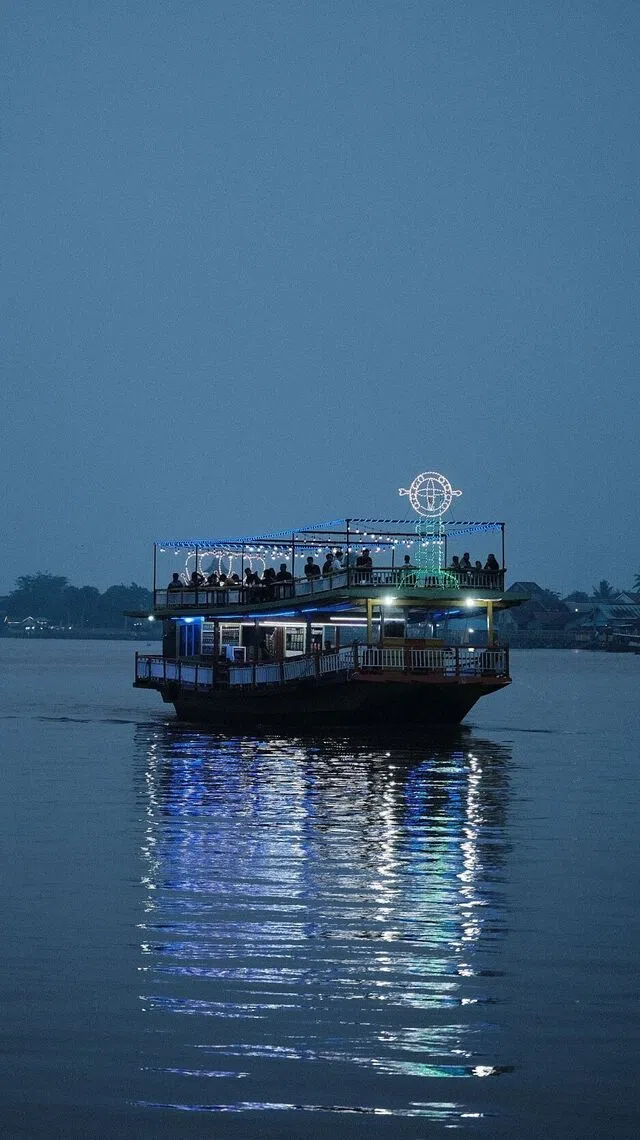
As night falls over Pontianak, the lights of a lone riverboat glow against the dark waters of the Kapuas, Indonesia’s longest river, where legend has it that female spirits known as pontianak once lurked.
Instead, for locals and Malaysian visitors who come from neighbouring Sarawak, Pontianak has two main claims to fame: being the only city in the world located precisely on the Equator and a bustling culinary scene – a result of the city’s unique blend of Malay, Chinese and Dayak cultures.

Statues outside the West Kalimantan Museum in Pontianak depict a man in traditional Dayak attire (left) waving next to a man wearing traditional Malay clothing, illustrating the city’s mixed cultural heritage.
ST PHOTO: KARINA TEHUSIJARANA
Culinary paradise
“There’s so much good food in Pontianak. Stick with me and I’ll show you everything,” Muhajir told me.
I met Muhajir, an ojek (motorcycle taxi) driver who goes by one name, when I ordered a ride back from my hotel. He saw the camera around my neck and immediately remarked: “You must be a vlogger!”
He became even more enthusiastic after I explained that I was a journalist working on a story about Pontianak. “You’re lucky you met me,” he said. “Other drivers might not know all the best places.”
Given the long history of ethnic Chinese in the province, it is unsurprising that one of the most well-known foods from West Kalimantan is choi pan or chai kue – rice flour dumplings filled with vegetables such as bengkoang or turnip, chives, mung beans and taro. The dumplings come steamed or fried, and you can wash them down with es jeruk kecil or calamansi juice.
Pontianak’s significant ethnic Chinese and non-Muslim populations – around 31 per cent and 25 per cent respectively – also mean that non-halal street food is more common than it is in most other parts of Indonesia.
One example is bakmie kepiting or crab noodles. Despite its name, the dish does not actually contain that much crab meat, partly because of rising prices of the ingredient. To compensate, the noodles come with fish balls, fish cake and slices of braised pork.
For those with a sweet tooth, Pontianak has plenty to offer too. One snack that provides a welcome respite from the city’s heat is che hun tiau. This shaved ice dessert contains sago-flour noodles, grass jelly, red beans, glutinous rice, coconut milk and palm sugar.

Choi pan or chai kue, a vegetable-filled dumpling inspired by Chinese cuisine, is a Pontianak and West Kalimantan delicacy. Popular fillings include turnip and chives, and they are usually served with fried minced garlic and a spicy chilli sauce.
ST PHOTO: KARINA TEHUSIJARANA

Bakmie kepiting, or crab noodles, is a popular supper food in Pontianak. Besides crab meat, toppings include fish cakes, fish balls and braised chicken or pork, depending on the stall.
ST PHOTO: KARINA TEHUSIJARANA

One of Pontianak’s signature sweet treats is che hun tiau, a shaved ice dish with a variety of toppings, including red beans, grass jelly and glutinous rice.
ST PHOTO: KARINA TEHUSIJARANA
But the dish that interested me the most was pengkang, which Muhajir eagerly introduced me to. It is a glutinous rice cake filled with small, dried shrimp called ebi, wrapped in banana leaf and grilled over an open flame.
Pengkang is usually served with sambal kepah, a very spicy clam chilli sauce. Though I cannot handle too much spice, the sambal was so good that I risked a stomachache to finish it.
If you need further proof that kuntilanak no longer prowl the streets, Jalan Gajah Mada, Pontianak’s business and culinary centre, remains lively all through the night, with food stalls and coffee shops remaining crowded up to the wee hours.
Some popular stalls open only in the evening. Muhajir’s favourite is Nasi Telor Ayong 999, a stall that has served fried eggs with rice since 1994. If it sounds very simple, that’s because it is.
But what makes customers willing to wait up to 30 minutes for a table is its special sauce – a mix of soya sauce, ebi and minced garlic that gives the eggs a very satisfying umami flavour.
“It’s good, right?” Muhajir asked me mid-bite. I nodded, my mouth too full to say anything.

Nasi Telor Ayong 999, a street food stall in Pontianak, draws long queues of customers at night hungry for its fried rice and other dishes.
ST PHOTO: KARINA TEHUSIJARANA

Nasi Telor Ayong 999’s bestseller is this plate of fried eggs with rice, drizzled with a special sauce.
ST PHOTO: KARINA TEHUSIJARANA
Beyond the food
One of Pontianak’s most popular historical and cultural sites is the Equator Monument, located across the Kapuas River from the city centre.
The site was first marked by Dutch explorers in 1928, with the Dutch colonial government building a permanent monument 10 years later. The Indonesian government built a bigger monument in 1990, but the original Dutch monument – a more modest wooden structure, marked by carvings of visitors’ names over the years – remains inside.
Twice a year, during the March and September equinoxes, the city holds a festival to celebrate the “shadowless days”, when vertical objects on the Equator lose their visible shadows.
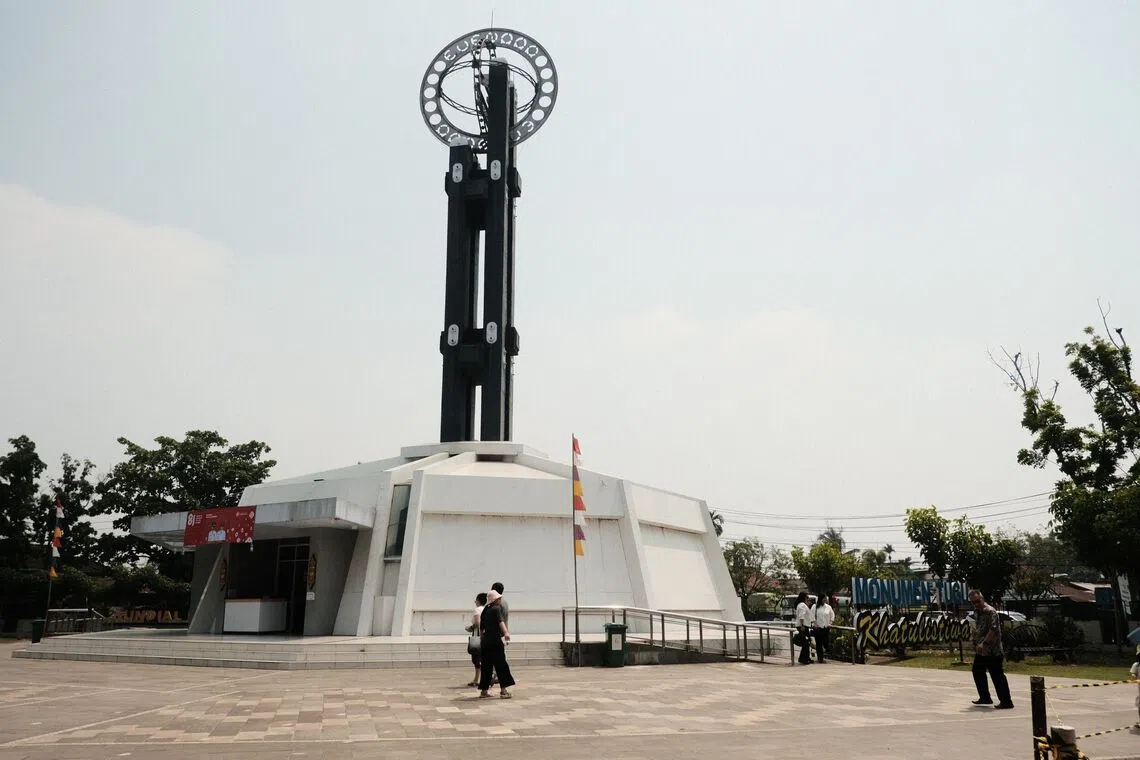
The Equator Monument marks the fact that Pontianak city sits right on the Equator line.
ST PHOTO: KARINA TEHUSIJARANA
The Kadriah Palace, built by the sultan who drove out the ghosts, also remains standing, and is still used for cultural and religious ceremonies.
Lina, one of the palace’s caretakers, told me that Pontianak’s seventh sultan, Syarif Abdul Hamid Alkadrie, was the designer of Indonesia’s national symbol, the Garuda Pancasila – something that I learnt only that day.
While Kadriah Palace is an example of a traditional Malay building, the city centre also has a replica of a rumah radakng or Dayak longhouse, with ornately carved pillars and statues of the helmeted hornbill – West Kalimantan’s official mascot.
Pontianak also serves as a gateway to West Kalimantan’s other tourist destinations. About three hours’ drive north of the city is the coastal town of Singkawang – known in Indonesia as “the city of a thousand klenteng” or Chinese temples.
Lodged between the Pasi, Poteng and Sakkok mountains and the South China Sea, Singkawang is one of the few cities in the country where Chinese Indonesians – mostly of Hakka and Teochew descent – make up the largest ethnic group, totalling about 42 per cent of the population.

One of the many Chinese temples found in Singkawang, a coastal town.
ST PHOTO: KARINA TEHUSIJARANA
Rough edges the real charm
I came to Pontianak with little knowledge and even less expectation, besides hoping to catch a glimpse of the notorious evil spirit. But what I found, with the help of Muhajir, was an abundance of food and history that even I as an Indonesian was not aware of.
For Singaporean visitors, Pontianak and its surroundings offer an interesting blend of the familiar and the new.
The city’s Chinatown area, with its rows of kopitiam serving kaya toast and soft-boiled eggs, might remind them of home, and Hokkien and Teochew speakers will find plenty of people to chat with.
But the food presents a unique twist compared with what is found back home, and the blend of Chinese, Malay and Dayak cultures that permeates the city’s architecture is a new experience.
A sunset cruise on Kapuas River, the longest in Indonesia stretching over 1,100km, is a popular tourist draw.
What Pontianak does not yet offer is polish. Tour operators are few, the boats that ply the Kapuas for sunset cruises are rickety wooden vessels, and the city’s museums are minimal and casually maintained.
Visitors expecting curated experiences will need to make their own, ideally with the help of an enthusiastic ojek driver.
But perhaps that is the appeal. For travellers bored with the same old destinations, the Equator City might be a good choice, especially now that it’s only a hop, skip and 90-minute direct flight away.
Produced by: Chang May Choon, Zurairi A.R, Siow Wong, Kelly Pang, Philip Cheong